Posts

The Wisdom of the Body 

In general, I live for walks and hikes and moving my body, but lately my body seems to want to do … nothing. Movement prone person that I am, my immediate reaction is that there’s something wrong. 

But then I remember that it is a good practice to listen to my body (oh yeah), and that perhaps it is signaling the need to rest more as the new season sets in. This said, I am in the process of determining if there is anything I need to address at a deeper level, but sometimes it’s simply about ebb and flow. 

Even if we are not aware of it, at the end of one season and the start of a new one we are in a brief transitional period and that can be a little disorienting for our body.

Change, even if we love the season we are entering, requires some effort.

Springtime Through a Holistic Lens

The integrative and holistic wellness system from India, called Ayurveda, suggests that feeling sluggish or “heavy” is not an uncommon symptom in the Springtime, here in the northern hemisphere. 

The reason has to do with the elements or qualities present in nature during this season. 

In the Ayurvedic system of health and wellness, we see our health through the lens of the four elements: earth, water, fire, and air

Everything in nature is also within us. For example, wind and air, bodies of water and rain, heat from the sun and fire, earth and soil.

Think about it this way: air is akin to our circulatory system, water represents our fluids, fire equates to our digestive juices, and earth is our density or mass.

Soft, heavy, cool, and sweet are some of the qualities associated with the elements of Spring, which are water and earth. Imagine the feeling of earth under your feet or hands. Now imagine the weight of water if you were carrying a bucket of it. 

If we consider that the environment around us is thawing after a long winter we start to understand why we might feel some lethargy in our body.

From Heavy to Light

Although our body might be rebooting from a winter slumber, the juxtaposition here is the feeling of lightness in the Springtime. 

The colors of the world, here in the Northern hemisphere, turn from neutral to vibrant, flowers are birthed all around us, and the air gets warmer and softer on our skin. 

Another image that comes to mind is shedding layers. 

When I’m on a hike I often wear layers. At the start of the hike the air is brisk but at some point as we climb upward with the sun radiating down on us, I realize it’s time to shed my sweatshirt and as I do, I feel much lighter.


But how might we cultivate our own light when we are feeling a little heavy? 

I find that when there is a feeling of inertia in the body or mind I have a really hard time beginning anything at all. I may contemplate the things I would love to achieve in a day, but the mere thought of them is exhausting and unless I make a plan, I may not get very far on my to-do list.

First I want to say that, sometimes, this is ok

We live in an achievement oriented world where constant “doing,” constant activity, is valued at the expense of “being.” So listening to our body’s rhythms and doing less once in a while can be highly valuable and also more productive in the long run. 

But how do we motivate ourselves if we are not “feeling it” and we need to get out of a rut?

The Thing About Procrastination

For me, it’s doing things in bite-size tasks. 

If a list of things, or even one full thing seems out of reach, I whittle that down to one small step I can handle right now. 

And I don’t put pressure on myself to get the whole thing done and usually, without that added pressure, I have no problem completing the task – the old Reverse Psychology. Then I feel a little lighter because I finished something and it is no longer sitting on my to do list. 

Procrastination usually feels heavy. 

If we are putting something off or avoiding it, it doesn’t just go away; it sits somewhere in our psyche taking up space. 

So, we can cultivate lightness by working on things in smaller pieces. Even if we get just a little bit done we have started, and that in itself feels lighter. 

Often starting something is the hardest part, right?

How Else Can We Cultivate Light

I like to work on things I enjoy, such as a creative or passion project. Do you have a hobby that sparks joy for you? 

Even if I have some trouble getting started, once I begin I quickly forget any resistance that hindered me and soon feel wholly engaged in the moment and immersed in the project – and this feels “light.”

Another big one for me is humor, along with the ability to see the bigger picture

Seeing humor in situations, especially ones that may have otherwise felt bleak, has saved me on many occasions. Laughter is the best medicine, right? A cliche that truly holds its meaning.

And when we take a step back from a situation or experience in order to “see the bigger picture,” we create space. The close-up vantage point of something shows us every harsh detail, but if we can  shift our vision or mindset into a more expansive and forgiving one, things feel, well, lighter. 

Another important avenue for lightness is community and connection

I’m a member of a hiking group; every week we meet at picturesque spots to traverse small or large mountains together, and when the weather gets warm there is an option to stay for a potluck picnic after. 

Few things feel more lighthearted to me than spending time in the great outdoors with fellow nature lovers. Community, connection, and nature. 

Just last weekend, I met up with my lovely hiking group at a spot on the Hudson River called Hook Mountain. We set forth on the 7 mile scenic path, along the Hudson River, before settling down for a picnic of homemade food (and with a water view to boot).

Did somebody say cultivating lightness? 

And the best part is that these things that make us feel the most lighthearted are mostly free

Money Doesn’t Buy Lightness

We don’t need a huge bank account to cultivate lightness. 

In fact, the more we have sometimes the more heavy we feel. “Mo money mo problems,” as the song lyrics go. 

We may think that buying new clothing or items or eating at that chichi restaurant will make us feel lighter or happier, and it might temporarily, but the truth is that accumulating things and overeating and drinking (which often happen when we go out to eat) are heavy, not light. 

When I was younger I chased the feeling of lightness. 

I thought going out to eat at restaurants (I was craving social connection) or buying something new (I was craving a new beginning or maybe a change in mindset) would help me feel lighter, but it rarely did … not for long anyway. 

I now understand that lightness doesn’t come from the external world of form: it is generally not found in things we can buy (once our basic needs are satisfied). 

It is found in the air on a mountaintop, in the sunlight shimmering down while we enjoy a picnic with friends, in the camaraderie of a group with a shared interest or passion, in the words of a meaningful story or text, in the care put into a homemade meal, in the feeling when we honor our body and give it a time-out or whatever it needs.

Balance in Body and Mind

I read something on social media recently that resonated with me. 

I’m paraphrasing but the author said something like this: “My yoga practice used to be about what it looked like (next to a photo of her doing an advanced pose on a bridge) and now it’s about what it feels like (next to a photo of her in a more relaxed and less physical posture, not on a bridge).” 

The first image conveys strength and triumph while the second conveys serenity and peace. 

Neither is wrong; our yoga practice is about the balance of strength and softness, and which side of the spectrum we lean toward will depend on where we are in our lives along with a host of other factors.

As a fellow yogi and teacher, I can relate to the evolution of a practice. 

For me, these days, feeling is much more important than appearance, which I suppose is partly due to aging and also due to the mind-body harmony we cultivate through our practice over the years … which really is the whole point of yoga. 

As our mind and body becomes more integrated, as we become more “alive” in body and spirit AKA the present moment, there is less of a need or desire to prove ourselves, “show off,” or create an image.

If we use the Ayurvedic lens of the elements (water, earth, fire, and air) to view the seasons, we have good insight on how to create balance in our own mind and body. 

Recall that in the springtime the water and earth are the dominant elements. And the practice of Ayurveda is centered on the principle of creating balance by bringing in the opposing elements. For example, we balance the elements of water and earth by adding a little fire (warmth or heat) and air (lightness!) to the mix

My yoga practice naturally shifts with the seasons. 

When we are in tune to our own body this tends to happen without too much effort, but it is always a good practice, at any stage, to bring more awareness to what our body may need with each new season and, especially, in the transition from one season to the next.

This means, we can move at a slightly faster or more invigorating pace in our yoga or movement practices (if this feels right in our body), or attempt more challenging postures or exercises to build heat (again, always honoring our own body first and foremost). 

We can also view our diet through the lens of the elements

Keeping in mind that our own individual constitution (AKA our mind-body makeup) will be the primary guide, it is usually beneficial to add a little spice to our food during this cool and wet season. 

Imagine having a cold or being congested. Would you want to eat oily or heavy foods? No, probably not (unless, perhaps, you are disconnected from your body); your body knows it needs a light warm broth, for example, or a little spice to clear out your sinuses, right? 

There is a similar theme happening during the Springtime. 

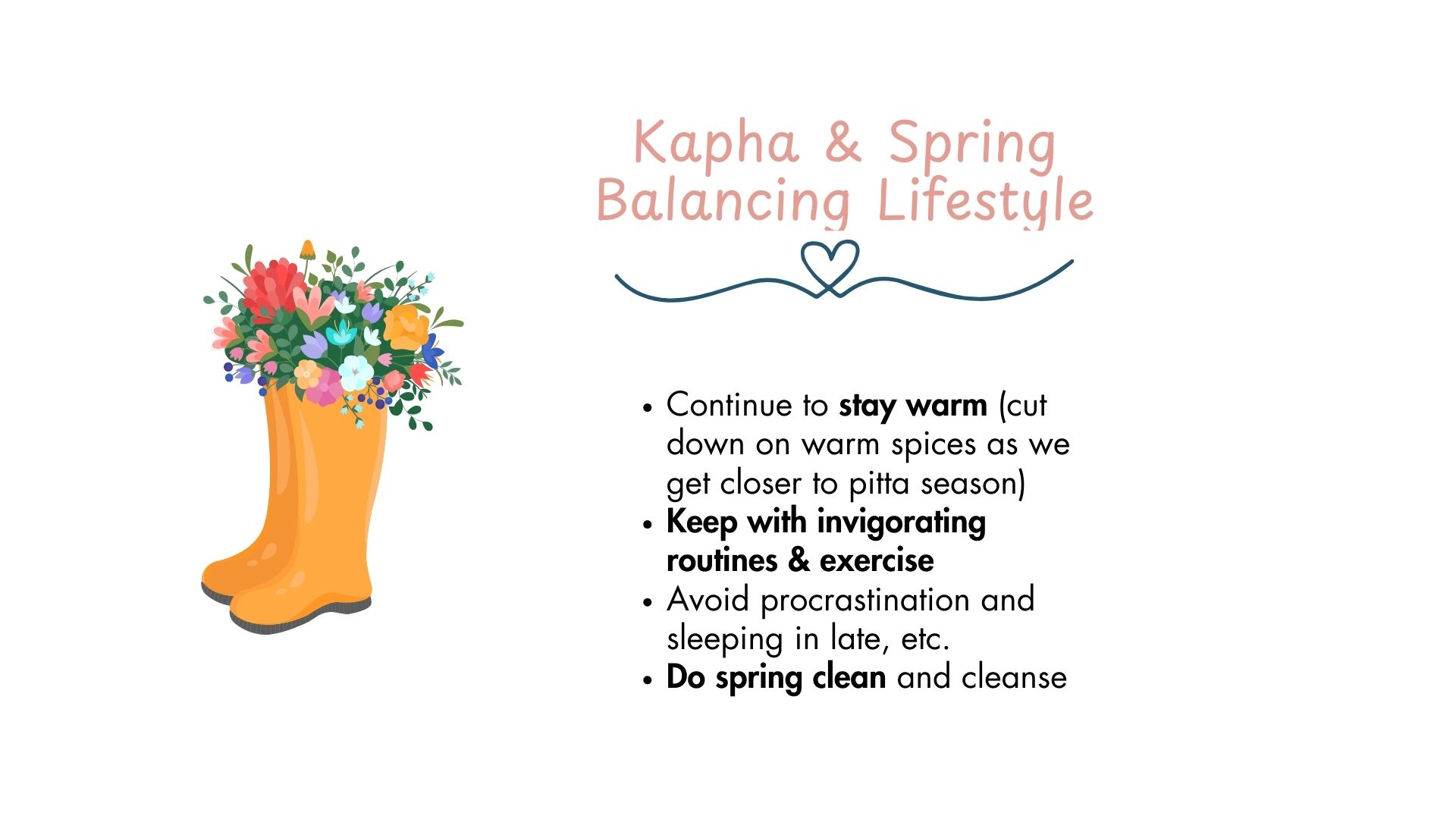
In general, during the Spring, we favor the warm, light, and dry qualities to balance the cool, wet, and heavy qualities. If possible, tend toward lighter meals with the mid-day meal being the largest, and try to avoid overeating. 

Lastly, breathing practices to favor during Spring are:

Kapalabhati Breath, AKA Skull Shining Breath, and Nadi Shodhana AKA Alternate Nostril Breath. These are two of my favorite breath techniques. 

Kapalabhati is known as a purification technique to counter sluggishness or heaviness in the body and mind. It works well for me when I am feeling a bit heavy in body and mind, and I tend to feel much lighter afterwards. 

It’s a short, quick, and fairly strong exhale out the nose with a more passive inhale, meaning you’re not as focused on the inhale, which happens more naturally; the emphasis is on the exhale as you draw your belly back rapidly, in rhythm with your breath, toward your spine (this helps to tone the abdominal muscles, which is a great practice in the Spring).

Kapalabhati Breath is said to strengthen the abdominal muscles, increase cognitive function, and promote mental clarity. It’s a perfect morning practice to give a boost of energy and vitality (I haven’t swapped it for my morning coffee yet, but some would say it’s better than coffee). 

*(There are some contraindications to be aware of as there are with most practices, such as pregnancy and those with high blood pressure or heart disease. In general, if you currently have any health issues consider a more gentle breathing practice.)

Nadi Shodhana or Alternate Nostril Breath is a more gentle breathing technique that helps to balance the brain hemispheres and settle the nervous system, calming the mind and body as the seasons shift. 

It’s a fairly simple practice once you get the hand configuration down. Place the thumb of your right hand gently on your right nostril and your pinky and ring fingers gently on your left nostril. The other two fingers can rest on the bridge of your nose. (This is how I like to do it; there are other variations.) Inhale slowly and fully through your right nostril and exhale through the same right nostril. The breath should be slow and steady. Now plug the right nostril softly with your thumb and inhale and exhale slowly and completely through the left nostril. Plug the left nostril. Note that both nostrils will be plugged for a moment in between sides; you can increase or decrease the “hold” depending on what is comfortable. Now repeat the pattern. Keep going just like that, from side to side, for several rounds.

Nadi Shodhana is helpful at any time of day when one needs to increase clarity, focus, steadiness, and general wellbeing, but I especially love to do it in the evening as I am winding down from the day.

*(Avoid this practice if you have a cold, are congested, or have respiratory issues. There may be contraindications for high blood pressure, heart problems, or pregnancy when it comes to pausing the breath in between sides, which can be easily remedied by doing a more continual breath.) 

Closing

Sometimes the opposite feeling or thing we desire is there to help us find the other side of it, and to create balance between the two. 

By accepting how we feel – rather than making the feeling wrong – we can work to bring more balance, and in the case of this essay light, into our minds and hearts and lives. 

We of course can’t feel light and carefree all the time. And we might not want to because then we wouldn’t appreciate the “light” as much, would we?

Just like passing clouds, rain, and thunderstorms our moods and energy levels change, too. There’s no use fighting against that and, in fact, when we accept things for how they are we tap into the whole rainbow of feelings that we might not have experienced otherwise. 

We can observe and appreciate the qualities in the clouds and rain and also use them to appreciate even more when the sunshine and flowers arrive.

In the Astrology system, there are 12 signs and houses, broken down into 6 pairs, or opposites. If you are already familiar with the anatomy of a Natal Chart and the concept of pairs or opposites (derived of two signs or two houses), you may want to skip to the next paragraph. If you look at a Natal Chart Wheel (for a free Natal Chart, go to Astro.com), you will see that the 1st house is directly opposite the 7th house, the 2nd house opposite the 8th, and so forth. Similarly, the sign Aries is opposite Libra, Taurus opposes Scorpio, and so on.

In my teachings (Yoga, Astrology, Holistic Wellness), I focus a lot on the idea of creating and maintaining balance in our bodies and lives, which we can do through the integration of opposites. In my yoga classes, I teach the poses in a way that encourages harmony between polarities: i.e., effort and ease, strength and softness, movement and stillness, the downward (earth) energy (Apana) and the upward (sky) energy (Prana). The foundation of my holistic wellness teachings, rooted in Ayurveda, is about cultivating the opposite qualities of one’s natural body/mind constitution in order to create and maintain balance.

You can think of pairs of signs or houses like a see-saw: if there is more weight on one side, it will plummet, fast and hard, to the earth. Remember the feeling when you were a kid of either descending to the ground with a bang (ouch!) or, if you were the lighter side, floating up up up to what felt like the sky, feet dangling, suspended in the air until someone released the other side or added some weight to your side?

At certain times in life, you see-saw along, both sides working together in harmony … and at other times you land with a thud, or float all the way up with no foreseeable way back down to the earth. During a challenging time in my 20’s, I was in a situation that would have yielded a lifetime of extremes, i.e., hard, painful falls versus rising, untethered, like a helium balloon … but never a middle ground, never peace. I had a strange dream during this time of a horse on a tightrope (how he got there, I do not know), being asked to perform a complicated ballet move. Performers on the tightrope were falling off of it to the left and right, plummeting to the ground, but the horse was somehow still standing, about to attempt his fancy move. Everyone was staring up at the him, motionless, waiting. I woke up with the word torture on my tongue. The poor horse had so much pressure on him to execute this move perfectly, to somehow propel himself into the sky, three times (no less!), and land  securely back down on the narrow piece of material suspended in the sky.

I knew I needed to leave the relationship/love triangle I had found my way into; a situation that involved three people being asked to accept unmanageable and unfair circumstances. I had known it for a while but I couldn’t admit it. A part of me was still pretending that we were going to have a “happily ever after” … this married man and I.

We are in Eclipse season again. Eclipses happen in the same sign for everyone (a collective energy) and, on a more personal level, they trigger a set of Houses in your Natal Chart. Eclipses (similarly to a full moon) can bring events to a head and therefore, sometimes, symbolize the peak moment of change. How much you feel the eclipse energy depends on your life circumstances (are you fairly balanced, or are you moving from one extreme to the other?) and whether or not the eclipse makes contact with your personal planets. If, for example, it is conjunct or making a hard angle with your Sun, Moon, or Personal Planets, you will likely feel its theme more strongly. It may be a lesson you are heeding or a truth that you are becoming aware of, so that you can shift your mindset and behavior, and something significant may be changing in your external circumstances, as well. The relationship I referred to above ended on the evening of an eclipse. We were at a bar, having a drink and a bite to eat, laughing one moment and crying the next. Something he said triggered a frustrated and emotional response from me and I challenged him about his living circumstances; I didn’t believe that he was sleeping in a separate bedroom from his wife like he had promised. We had had many arguments about related subjects over the past couple of years but this one felt more intense and like we had hit a dead end. He broke his glasses in two at the bar, and we got the check. Outside, he punched a sign and started crying. We both knew it was over.

Eclipses can bring endings and, also, beginnings, like the birth of a child or the debut of a book.

In the approaching Eclipse (on April 30, 2022), Uranus has joined the mix, and Uranus signifies change and freedom, adding to our theme of potential change. The upcoming New Moon Eclipse is in the sign of Taurus, therefore the Taurus/Scorpio polarity is activated, which signifies your self value, what you own and what you do in the world to make a living (Taurus) versus your intimate relationships and shared resources (Scorpio). Is one side out of whack (down low or precariously high?); if so, what can you do to create greater balance and peace in your life? At the New Moon, both the Sun and Moon touch down in the same sign (Taurus), as opposed to the Full Moon, when the Sun lands in the opposite sign of the Moon. In my view of Astrology (a Psychological perspective), we are always working with polarities; when one side of a pair is triggered the other is, too, by default. The Full Moon Eclipse, which follows the upcoming one, will land in the opposite sign and house in your chart; for example, the New Moon Eclipse, on April 30, 2022 is in Taurus, as stated, and a few weeks later, on May 15th/16th, the Full Moon (Eclipse) arrives in its opposite sign (Scorpio). Usually, the Moon lights up the opposite house in your chart (or close to it).

The saying “opposites attract” points to an important truth that within each experience, theme, or archetype lives its opposite. It’s common, for instance, to be drawn to the so-called opposite personality traits of your own because the ‘opposite’ lies dormant within you like a buried treasure, waiting to see the light of day. You can connect to the latent traits, feelings, or emotions within yourself through the other. Opposite traits can create balance in a relationship dynamic, if you do the work (it can also, obviously, be combustible if the opposite energy is extreme with no middle ground), whereas too much of the same trait or theme can create imbalance; this is a core principle in Ayurveda.

The New Moon Eclipse lands in my 6th House, ruled by Virgo … so, I will reflect on the lessons of the 6th/12th axis (ruled by virgo and pisces, respectively) energies, which are something of a theme in my life (due to Pisces on my 4th house cusp and Virgo on my 10th, and Chiron in my 6th house). The forest versus the trees is the metaphor that comes to mind for this pair.

I will also list below the themes you may be working with for all other sets of houses (i.e., 1st/7th houses, 2nd/8th houses, 3rd/9th houses, 4th/10th houses, 5th/11th houses) for this Eclipse season, or any future ones.

The 6th house, Virgo’s domain, represents the minutia of life. It reflects daily habits and routines, work/day-job, and health, which includes one’s daily health/self-care regimen. The 6th house teaches lessons about the practical aspects of life while the 12th house, its opposite, points to “the beyond” — the magical or spiritual aspects of life. In the 12th house, we learn how to “be.”

There was a bee inside the store I work at. It was a warm day and I had the door open. He flew in and could not find his way out. I heard him buzzing around and slamming his small insect body into the front window, unable to understand why he could see “the outside” in front of him but could not reach it. I am an animal/being lover, but since little I have had an irrational fear, more like phobia, of bugs (it is not as bad as it used to be). I fretted over what do; how could I trap him momentarily so that I could lead him to the door? Was it a bumble bee, was it a wasp? Would he sting me? He grew quiet for a long time and I almost forgot about him as I tended to things at work. I prayed he had found his way out and I wouldn’t have to “deal,” but when I walked over to the front window to investigate the situation, I saw that the little guy was just sitting listlessly on a window display. I remembered we have a tool in the store that looks like a giant bug net (it is a sieve used for making herbal and skin remedies) and contemplated how I would trap him until I could get him to the door. I didn’t have to think on it long; in his weakened state, he simply climbed on board and stayed there for the ride to the doorway. Once he sensed the outside, he flew to a tree in front of the store and landed on a flower, where he, I imagine, received the nourishment he needed to survive. I watched him for a few minutes, overwhelmed with emotion, relieved he had found his way … and mad at myself for not helping sooner, for allowing my juvenile fears to get in the way of offering a lifeline to this small creature in need.

I am at a life crossroads that feels more like a permanent stoplight. Like the bee, I feel trapped. I see everyone else through the window, living their lives and moving onward, but I am stuck behind, what feels like, an insurmountable wall. It is not lost on me that one of the stores I am currently employed at, a business owned by a family member, is a place I had worked at many years ago, when I first moved home from California. It was, similarly to now, a transitional phase of my life, a period in which I felt lost and lonely and unsure of my next steps. I had left a dead-end and wildly unhealthy/inappropriate relationship (the horse on the tightrope), as well as a job in the Financial world that felt the same way. When I moved home with a broken heart, I loathed working at my family member’s clothing store; it seemed to highlight all my failures. I had spent so much time on my education and had big (unclear) goals and nothing had worked out. Landing at a retail job — the type of job I worked at in high school — felt like rock bottom. I bided my time there and felt pretty much miserable each day … then I’d go home and pig out on take-out and ice-cream: escapism behavior (the distorted side of the 12th house). Suffice it to say, I was not a dedicated employee. I was barely present, lost in my thoughts and job searching on the computer every chance I could get, rather than thinking about what might need to be done in the store, like cleaning or putting together gift boxes: monotonous chores (6th house). I didn’t like talking to customers because I despised small talk and the role-playing; it all felt phony and hopeless.

So when the opportunity arose last summer to work at the same store for the same family member, it dawned on me that  it was something of a “do-over.” I didn’t have to force myself to be the devoted employee I once wasn’t — it just happened naturally. After so much time at home (during the pandemic) and a lot of “growing up” over the past decade plus, I genuinely enjoyed chatting with customers; people seemed much nicer and more genuine than they had back then (interesting, right, how your reality can shift when your mind state does?). I was also tackling my health/addictive behaviors — eating better and getting more sleep as a result. I had much more energy than I did back then, which was key to focusing on small tasks and helping customers. I felt good/balanced instead of exhausted and miserable. Although this is not what I expected (or want) to be doing at this stage of my life, and if I allow my mind to dwell on my mistakes and failures it takes me to a sad/low place, I mostly focus on my connection with each customer and doing chores with presence (rather than wanting to escape). In the the 6th house, we learn to be of service in the world and to be humble, to put aside our own (perhaps misguided) desires and tend to our responsibilities. Although the 6th house is associated with chores, when we give ourselves fully to these chores, when we perform them with care, we can connect to something bigger (the 12th house). In the 6th house, we “practice” while in the 12th house we create.

In life, there are often opportunities (if we notice them) to circle back to experiences left incomplete, or experiences in which we failed lessons that there were there for the learning. The first time around, at the clothing store, I failed big time. I rationalized that I loathed retail and while it’s true that Sales is not my forte, I understand now how important and crucial taking pride in your work is, whether you are sweeping the floor, entering a sale, doing inventory, or watering plants (“chopping wood, carrying water” as the Zen saying goes). The first time around, I focused on my escape plan. I was missing the point that if you do your tasks well, you feel the satisfaction of a job well done, even, and especially, if it is not a job you feel suits you, or that you would like to do long term (or even for another week). We create opportunities and new paths for ourselves by embracing our reality rather than running from it.

Candy Land was one of my favorite childhood board games. When I think about my past, I imagine sliding down a backward ramp to where I just was, getting stuck in a swamp, or re-routed to the beginning of the game, when my teammates are making their way through the lollipops and gumdrops to the finish line (I don’t really remember the order of the candy trail but you catch my drift). When we learn the lessons, we get to move forward in life.

In the 6th house, we learn to commit … to our responsibilities and to ourselves. We mature.

The 12th house, on the other end of the wheel, is where you can deceive yourself into thinking that “somewhere out there” is a utopia, but if you don’t fall into that trap it is also full of beauty.  The lesson of the 6th/12th houses is that you create your own utopia by doing the work.

If, on the other hand, life becomes so focused on the nitty gritty of the 6th house, it can feel like “all work and no play” or Ground Hog Day. That makes me think of Jack Nicholson’s terrifying character in The Shining, when his wife discovers that the hundreds of pages of the novel he has been writing are nothing but the same sentence over and over: “All work and no play makes Jack a dull boy.” I digress. If you wake up joy-less with nothing to look forward to, you may be in a 6th House rut. And that is exactly what happened to me recently. I am working 7 days/week (two part time jobs, plus teaching yoga). At home, I am preoccupied with cooking, cleaning, laundry, and taking care of my fur babies. I don’t have time for anything but work and chores.

At work, a couple of weeks ago, my emotions hit a boiling point (it was a few days before the last full moon). It felt like an internal breakdown. If I wasn’t at work, I would have crawled into bed. I was tired (from not sleeping enough) and wasn’t making time for exercise and yoga. Additionally, I have been diligently applying to full-time positions (that might lead me to a career path) for a long time with no results; the applications take a lot of time and effort, and in return I receive mostly formulaic rejection emails or, even more depressing, no response at all. I couldn’t help but feel like all my effort was for nothing … that I was spinning my 6th House wheels and getting nowhere. Why couldn’t I get out of this dead-end situation and find my way to where I needed and wanted to be? I was nearly in tears.

Amidst all the chores I was doing, I had no time to just be. I was on the heavier end of the see-saw, stuck on the ground.

The 12th house, Pisces territory, is where we find meaning in life … and unicorns and fairy dust. The stuff dreams are made of. A ferry ride on the top deck under the bright full moon and inky sky. A moon-lit walk on a pier with water on either side and twinkling lights in the distance. Fleeting moments of otherworldly beauty. These 12th house moments connect you to something greater than the self and your everyday reality … these are moments that fill the soul.

I had been neglecting my yoga and breathing practices because it was hard to squeeze it in in the morning and I was tired at night, but after the mini inner-breakdown I made time for my practice and noticed the feeling of space it created. I took a walk by the water a few days later on Sunday afternoon. I felt refreshed and renewed after my walk, and vowed to find the time for my well-being (6th house) so I could connect to the feeling of “being” (12th house).

What I also realize is: the more I focus on feeling trapped or stuck, the more frustrated and out of sorts I become. I know this lesson well, but we often need to go over the same lessons many times in a lifetime before they really stick. On the day at work when I felt emotional and exhausted, I was avoiding any tasks I had — I couldn’t focus and just wanted to go home. And that is more than understandable sometimes … I usually complete all my tasks. When I returned to work the next day, with a different mindset and less exhausted, I tended to the details in a calm and focused way — I vacuumed, swept, watered the plants, and communicated kindly with customers. I felt satisfied and lighter. Nothing in my external reality had changed: I hadn’t gotten the job overnight, or received an acceptance letter from a literary magazine (something else I have been working on for eons), but I felt the freedom that comes when you accept “what is.” My main man/guru, Eckhart Tolle, teaches about acceptance; his wise and simple teachings were my introduction to this truth many moons ago and life-changing. I continue to work with and re-learn the lesson of acceptance. Acceptance lives in the 12th house. Interestingly, so does addiction, which makes perfect sense if you think about: addictive behavior is used to resist your present life situation; when you overcome addictive or avoidant behavior you are met with the utopia or bliss of acceptance.

The way out is always through (the doorway, not the glass window, dear bee).

A distorted 12th house mirrors avoidance and escapism behavior, falling into the trap of thinking the magic is always elsewhere. It’s easy to fall into that mindset if your daily life feels disconnected from your bigger goals and dreams or life purpose (like mine do), and there may be something that needs to shift so that more 12th house magic can enter your days, but it is also up to us to create the magic and meaning even and, especially, in the dull moments and periods of life. My career path  (if I ever get there) will likely contain as many or more headaches as the “day job.” It will be worth it, I’m sure, because I’ll care about my work but I also know my salvation is not the dream job. My salvation is the present moment.

First find the magic in the “day job,” in the ordinary, in all the annoying chores that make up your everyday reality. And then, perhaps, by the grace of god (or a kind soul), you will be guided to the doorway that leads to the flower that will nourish and sustain you.

***

*Note that if the Eclipse hits your Sun, Moon, or Personal Planets, you may feel it more powerfully. If the eclipse, however, does not make hard aspects to your natal planets it is likely that it will pass without much ado.

To reiterate, the New Moon Eclipse is in Taurus. In the case of a New Moon, the sun and moon shine in the same sign as opposed to the Full Moon, when the sun and moon reside in opposite signs. The upcoming Full Moon Eclipse, in May, arrives in Scorpio and therefore highlights the Taurus/Scorpio axis. In the case of the Full Moon, it is common to feel more emotional or unbalanced than at the New Moon because your inner self and outer selves can feel at odds; the moon represents your needs and feelings (it’s the feminine energy) while the sun (the masculine) represents your drive and ego (i.e., what you want versus what you need). At a New Moon, the energies of Sun and Moon tend to blend better, while at the Full Moon they can feel disparate, with a need for integration. I often point out in my yoga classes that we are, via the union of breath and movement, bringing together the disparate parts of ourselves, the parts that may have gone offline.

Scorpio is the opposite or underbelly of Taurus, and vice-versa. The opposite side of something is always part of the picture whether or not it is in our awareness. Taurus represents things you value, including yourself, and on a more practical level the way you earn money or “worth” in the world, including your level of self-sufficiency. Scorpio symbolizes your intimate relationships and the things you don’t see, i.e., the stuff under the surface. If Taurus is your physical stuff (what you have built and accumulated – the stuff you may feel attached to), Scorpio points to what is buried underneath that stuff (there is usually a lot of dust underneath stuff, waiting to be cleaned). Scorpio is about intimacy and shared resources, as mentioned above, and releasing “stuff” so it doesn’t drag you down — it also represents digging for meaning and healing wounds.

Below, I list the Pairs of Houses. You can read for the New Moon Eclipse in Taurus (April 30th in Taurus), the Full Moon Eclipse in Scorpio (May 15/16 in Scorpio), and any future Eclipses — and, also, for House Themes in your Natal Chart (e.g., the IC/MC, Ascendent/Descendent, North Node/South Node).

Eclipse in your 1st/7th House Axis: You will likely face issues around your identity versus your relationships. What you need and want versus what others need and want. The 1st house represents the self and the 7th house symbolizes your connections, and how you see yourself through other people’s eyes. What side of the see-saw are you on when it comes to self versus relationships? Are you stuck on the ground, weighed down by a dead-end relationship or one that is stunting your growth? Or are you floating, untethered, in one that likely won’t lead anywhere? Or, perhaps, you are alone and wondering where everyone has gone? If you are feeling disconnected or unsupported, it may be because you have let go of a relationship that is no longer appropriate for you and are now in a transitional phase that will lead to a more balanced life. On the other hand, you may have self-isolated due to carving your own path, for example, and did not want to be bogged down by others. Or, perhaps, you have fears around commitment and would like to have more genuine and fulfilling relationships in your life. Whatever your truth is look at it in the face, reflect on what you can do to move forward in a more fulfilling way … and then do it.

Eclipse in your 2nd/8th House Axis: You may be dealing with issues of self-worth reflected by your income, business, and possessions (or lack thereof) versus intimacy and shared resources. What does the see-saw feel like in this area of your life? Are you more of a “taker,” fearful of sharing with your partner or loved ones, or do you perhaps rely on your partner or family too much for support and would feel more confident if you created your own source of income? The 2nd/8th house axis is, like the 1st/7th houses, a “me versus we” theme; in this case it is you and your stuff versus you and your partner and your joint stuff. Of course, the “stuff” I speak of may be emotional/non-physical and, usually, it is both; our physical stuff mirrors our mental stuff. In the 2nd house you develop your self-sufficiency, and in the 8th house you learn to share and to build important relationships or partnerships. If the Eclipse is in this house axis, you have a double dose of the Taurus/Scorpio theme, discussed above, because Taurus rules the 2nd house and Scorpio rules the 8th house.

Eclipse in your 3rd/9th House Axis: Themes of your daily thoughts and words/communication versus a wider perspective or higher mind, publishing your work (perhaps), and a sense of freedom versus being in a smaller neighborhood or area could be coming up for you. In the 3rd house we do a lot of thinking and absorbing of information, and this pair of houses is connected to your belief system, which is made up of information you receive or have received and repetitive or ingrained thoughts. If there is an area of life where you feel stuck or unfulfilled, you may be called to examine your belief system and determine if that is, at least in part, at the root of the current circumstances. The 3rd house represents teaching and learning at a more cerebral (or sometimes mundane) level, while the 9th house is all about bigger-picture topics and subject matter, like religion and philosophy, and points to teaching and learning that is inspirational or has a wider scope. Maybe you are considering going back to school or take some type of online education program that will enhance your day job or daily work. You may also be working on a writing project and are considering publishing. Another manifestation of this house polarity is that you do a lot of local travel and are tired from all the commuting and want more freedom/ “space” in your schedule; a move somewhere further away could be part of the story.

Eclipse in your 4th/10th House Axis: This is the axis (called the IC/MC) that runs vertically down the center of your chart. The signs on the cusps of these houses are usually recurring themes in your life (as in my story above). The 4th house reflects your home and private-life — the inner you — while the 10th house symbolizes your place or standing in world — the outer or more visible side of your personality/identity. The 4th house is connected to your home or nest, childhood, parents, and memories while the 10th house is connected to your career, outside life, and social standing or place in the world. When this house axis is highlighted during the New Moon Eclipse, you may face themes (we tend to feel the eclipse in the days and even weeks beforehand, btw) involving your home or inner self versus “where you stand” or how you are seen in the world, including your worldly accomplishments. How do you balance your home (and, perhaps, family) with your career or outside life and obligations? Usually, one side of the spectrum needs more attention and, if this is where the eclipse makes itself known in your chart, you likely know which side needs to shift for greater work/life balance.

Eclipse in your 5th/11th House Axis: This pair of houses is about your need to shine in the world versus being a part of a community or collective effort. In the 5th house, you share your creative gifts with others (you seek recognition for your talents), while in the 11th house you use your gifts for the greater good, in the name of higher-minded pursuits or worldly-responsible goals. This house axis, like the 1st/7th and 2nd/8th, highlights the “me versus we” theme. What are my natural gifts and talents and how can I receive recognition or accolades for them, versus how can I use my gifts for bigger picture pursuits? In the 5th house, we strut our stuff and want to take center stage, while in the 11th house our creations may become an integral part of a bigger movement or cause, which can bring even more satisfaction. Another way this house pair energy plays out is in friendships versus romantic involvements. The 11th house represents your friendships while the 5th house depicts your lovers. In some cases, friends become lovers or lovers become friends; the most fulfilling love relationships are often those that began as friendships.

Eclipse in your 6th/12th House Axis: See above for my story and ton of info. on this polarity.

The operating system of my Mac, the tech told me, did not have enough internal space. It was stuck. It could not go back to the old operating system but it also could not go forward. My only option was to delete the old operating system, with all the rows of folders, full of e-papers, and everything else the laptop had accumulated over the years. My heart sped up. I took off my sweater. I thought of all the essays I had been working on and various documents and the photographs … all the stuff.

I had no choice if I wanted a working computer, so I calmly said, “Yes, let’s go ahead and do that.”

It started a week ago. I began a Kundalini yoga practice to clear out “stuck” emotions and the past. I have been working on this, on and off, for years. I’ve cleaned out my closets and simplified my life, and although I have made progress and significant changes, I’ve been holding onto the past in a few forms, such as relationships with unavailable people and overeating/overindulging, which started when I was young. Food and gifts and goodies got wired together in my brain with, you guessed it, love (and, I think, security and safety). I developed an insatiable need for more … more delicious food (even though I was stuffed), more sweets (one dessert at night was never enough, even though my body was telling me it could not handle the sugar), more nice things, like expensive clothing (even if my bank account was in a precarious place). In a nut shell, dysfunctional behavior. It was all in an unconscious attempt to connect to a feeling of being loved and not alone (in the lonely sense), which starts with feeling that L-word for yourself (that’s Chiron in Taurus in my Astrology chart, for those who care :)).

I was able to transform many of my self-defeating habits, like spending on clothing and things I didn’t need. After some time with a consistent yoga/meditative practice, it became clear that shopping and constantly searching for something to fill the void wasn’t bringing me joy and, if anything, was making me unhappy. Instead, I focused on practices that were nourishing me, like yoga and walks/hikes in nature and connecting genuinely with people on a similar path (for so many years, I was in hiding, disconnected from myself, others, and the world).

So, last summer, motivated by my mother’s death, I took a look at some of the habits I was still holding onto and how they keep me stuck in patterns that stunt forward movement in a positive direction.

After the devastating experience of witnessing my mom become sicker and sicker due to tumors in her liver and all the chemicals to try to slow down the process, I decided to “get serious” about my health. I have, for most of my life, been fortunate to eat well, to enjoy fresh food, starting with my grandparents’ big vegetable garden in our backyard (my childhood roots), and I care about my health (hell, I have certifications in Ayurveda Counseling and Yoga), but I also have the aforementioned overindulgent gene, plus a mean sweet tooth that comes out at night. The witching hour.

Last June, the month of my mother’s birthday, I finally changed my eating habits.

In the Ayurvedic system, your individual constitution, or body-type, determines which foods and daily practices are most supportive and balancing for you, so what works for me may not be the exact right fit for you. Traditionally, the Vata (or air element) Dosha, which is one of my primary Doshas, does well with a little meat and dairy, but as mentioned above, due to our chemical-laden commercial food system and, also, for ethical reasons (how animals are treated and the effect on the environment) I cut way down; I tried to cut them out entirely, but when I have too many dietary restrictions I feel confined and start to rebel, so I settled for having meat and dairy every once in a while and doing my best to eat organic, grass-fed, etc. when I do.

The dietary and lifestyle changes I’ve made have lead to happier mornings. I used to say “I am not a morning person,” but that was in large part due to abusing my body the night before; I was depleted, fatigued and unfocused, from all the refined sugar and also eating more than my poor system could handle. In the practice of Ayurveda, eating when you are not hungry is one of the worst things you can do. I have more energy now than I’ve had in a very long time — maybe ever. I slip up, now and again, and go back to my old ways, but, mostly, it just serves as a reminder that I don’t want to feel stuffed and heavy, anymore. I am done with that state of being. Being stuffed is a way to not feel, to avoid and numb out … the same as a drug. These days, I’d rather feel clear and light enough to do a meditation before bed, or at least feel good/balanced when I go to sleep.

About a week into my kundalini program, which is, basically, intensive breath-work along with movement, I was feeling a shift — brighter. Then stuff starting coming to the surface. Old stuff. Rejection. I had a dream about waiting in line for coffee; I was last in line and got the last, not even full, cup of cruddy, muddy looking coffee. I stared it, wondering, what the heck happened to that poor cup o’ Joe. I accepted the coffee, after waiting so long for it, even though I wasn’t sure I could drink it. In the same dream, I became aware that I was purposely not invited to a party, or gathering, that my friends were having; I felt excluded and betrayed. I am conjuring up one of my favorite childhood books here, Alexander and the Terrible, Horrible Very bad, No Good, Very Bad Day). Next, I was at work, at a store; customers had come behind the counter, in my space, without asking; they were blow-drying their hair and putting on makeup, and being loud and disrespectful, even though they knew I was trying to work and that they didn’t belong there. I asked them to leave and said there was a bathroom down the hall where they could do their primping. All of these strange, seemingly disjointed events seem to be pointing to getting the raw end of the deal or short end of the stick, as they say, and a need to value myself and affirm stronger boundaries (the root cause of the self-defeating habits and my Taurus/Chiron combo, which is also connected to my moon and sun, by the way.).

Simultaneously, and for the last several months, my website was under attack. I was receiving multiple emails, weekly, from my website security app. that indicated someone or something was attempting to log into my site from various IP addresses; they’d try, over and over, and get locked out and then try again the next day or week. They’d been at it for many months, determined to “break the code.” I mostly ignored it because I didn’t want to spend extra money for a website I wasn’t utilizing, but I changed my password frequently in hopes that I was a few steps ahead of the hackers.

The day before my operating system deletion, I decided to strengthen my website security once in for all; be gone with you, pesky hackers. I had started writing blogs again and I have been working hard on them, so I didn’t want some a-holes holding my writing for ransom. I called Go Daddy and added a firewall. Take that.

The operating system, the tech told me, did not have enough internal space. “You mean the only way is to delete everything on my computer?”

“Yes, I’m very sorry, she replied, her voice was small and quiet, as if someone had died.

The only way out was a new system. A wipe-out.

I assumed I had lost everything and wasn’t able to fully comprehend in the moment what that meant, and even though I was anxious and knew I might be devastated later in the day, I also felt, weirdly, excited and ready.

My prior desktop was filled with rows of folders, many of them filled with documents I had not opened in many years. Now I stared at a blank and unfamiliar screen. I opened icloud and discovered that most of my essays and important documents were saved there. I pressed my hand to chest. Whew. All of that work on so many essays, over many years, had not vanished. My apps were gone, however, including my Astrology app. that I use to create natal charts (after two inquiries to the company I still haven’t been able to retrieve it, but that is “a small price” compared to what I thought I had lost).

I have the sense of a clean slate when I look at my new blank desktop, and I am hesitant to save anything to it; I like the look of it.

My next project is to go through my documents on icloud and, slowly but surely, delete everything I no longer need.

Ayurveda translates to the Wisdom of Life. I like this definition because it reflects the truth that wellness and health cannot be separated from the larger whole. Our bodies and beings are intrinsically connected to our environment, to the larger whole: what is outside of us is also within us. 

Ayurveda philosophy is rooted in the three Doshas or Constitutions, which embody the elements of nature: they are Vata (air and space), Pitta (fire and water), and Kapha (water and earth). According to Ayurveda, there is no “one size fits all” approach for wellness. For instance, a raw food diet, although it may work great for a Pitta dominant person, can wreak havoc on a Vata dominant person’s digestive system. I am a Vata dominant person so I can attest to this: Vata people are delicate like flowers while Pitta people tend to have a “strong constitution.” There are, however, daily morning practices, called Dinacharya, that work well for all three Doshas. They can also be tailored to meet the specific needs of your current state of being (note: your current state may differ from your dosha/natural constitution).

Below are the daily morning Ayurveda practices that I have committed to. They are simple and yet the accumulated affect is that I feel more grounded and balanced in the morning (the morning has always been difficult for me so this is a big deal). I encourage you to adopt any or all of these morning practices. If you’d like to learn about your natural constitution and current state of being through an Ayurvedic lens, I offer an online Ayurvedic Assessment and Wellness Plan.

  1. Use a tongue cleaner before brushing your teeth and on an empty stomach (7-14 scrapes). The Ayurveda perspective holds that a tongue cleaner is essential as a toothbrush because it helps to reduce Ama (toxins) in the body by keeping the bacteria level in the mouth healthy and stimulates the cleansing of the gastrointestinal tract.
  2. Drink a glass of warm (not cold and not hot) with lemon – this helps to soften Ama (toxins) and is cleansing for the system. *If you need to stimulate Agni (the digestive fire/metabolism), add fresh ginger.
  3. Meditation and/or Pranayama (I know this is a ‘toughie’ but you can make the time for at least 5 minutes! Shoot for 10 -15 minutes, but 5 is a great start.) *Pranayama is yogic breathing techniques for, for example, centering or stimulation/energy. This breath-work can be tailored for your dosha and/or current state . The benefits of meditation are many! A few I have noticed since I began meditating on a daily basis are greater mental focus and an ease of expression (i.e., easier time finding the “right” words), a feeling of contentment and more balanced emotions.
  4. Oil Pulling. On any empty stomach, take a tablespoon of Sesame Oil or Coconut Oil (or blend of the two)- swish it all around your mouth (in front and in back of your teeth) for at least 5 minutes and up to 15. It takes a little getting used to but there are many benefits! A few are: healthy teeth and gums, improves respiratory health (helps with allergies and asthma), supports the body’s process of releasing toxins. Banyan Botanicals, a site I used for my Ayurveda Products, developed a product called Daily Swish that has peppermint and spearmint essential oils so the taste is more palatable!
  5. A splash of cold water on face/eyes. This reduces heat or leftover pitta energy from the night, when your body undertakes repair work. It’s also stimulating and refreshing.
  6. Before shower or about 10 minutes after, put 1-2 drops of Nasya Oil in each nostril. This is a blend of  oils, herbs and essential oils. The nostrils are a direct passageway to your brain and in order to feel well and balanced this passage needs to be clear and unblocked so the breath/prana (life force) can flow. Nasya Oil helps to clear congestion, cleanses the tissues, supports mental clarity and is said to improve vision and the quality of the voice.
  7. Self Massage: I love this one as it especially beneficial for my prominent dosha, the Vata dosha. If you are a fellow Vata, you can do this after the shower like I do because your skin tends to be dry, but if you have oily skin this can be done before your shower. I use Sesame oil and this is the preferred oil for the Vata dosha (Sunflower or Coconut oils can be used for Pitta, especially during the summer months, and dry brushing may be more appropriate for Kapha). I add a few drops of essential oils, which is optional (lately I use Lavender and Eucalyptus). Massage the oil on your body, using long strokes on limbs and circular strokes on joints and broad circular strokes on belly (clockwise) and chest. There are lots of benefits, such as: improves sleep, promotes healthy skin, nourishes the tissues, stimulates circulation and the internal organs. This takes me about 5 minutes in the morning and truly makes me feel more grounded and supported. The oil is like a protective layer on your skin as you navigate the different experiences and energies of the day, and so, as I mentioned, this practice can be especially helpful for Vata because Vata people tend to be sensitive/delicate.
  8. Sun Salutations and Moon Salutations. Take 5-15 minutes to practice morning Salutations. Switch it up to Moon Salutations during the Full Moon Phase or any time you’re in the mood for a softer morning yoga routine.

Today I’m thinking about how yoga teachers can present cues and comments in a positive and open-minded way. Are you supporting and encouraging your students? Are you being kind and compassionate, or is your tone bordering on bullying and nit-picking due to your own issues of perfection: We can only be open and accepting of others if we are that way with ourselves, right? As a person who is ridiculously hard on myself, a recovering perfectionist, (and I don’t mean that things I have created have resembled “perfection” but that I held myself back from creating anything at all due to illusions of perfection) believe me, I am the first to admit that this isn’t always an easy task.

That said, one of my greatest goals as a teacher and, I believe, strengths (due to my own life experiences and lessons) is enabling students to feel accepted no matter what state of being they stepped into class with that day, whether that is a fiery need to conquer their practice (they may have excess energy to burn) or the desire to lay in Savasana the entire time (they may feel depleted). I am here to say that it’s not always a perfect balance of “effort and ease” even though we may aspire to it. And although I love to remind my students of the beauty of this message (of effort and ease/strength and grace), I recognize that sometimes we need to play with extremes, and that that’s okay too. After all, yoga is about acceptance of this moment, not forcing something or someone to be different. As Eckhart Tolle reminds us: “Whatever we resist persists.”

Recently, in a yoga class I attended, the teacher , after a challenging posture, inquired, somewhat sharply: “Were you burning a hole in the floor with your gaze?” I paused, feeling, for a moment, ashamed. Was I? I may have been. My gaze had felt intense and focused, and there may have been, ahem, blue blazes emanating from my eye balls. I am vata-pitta (air and fire elements) constitution, according to the ancient science of Ayurveda, and was feeling my pitta (fire) that day. So perhaps I was guilty as charged. It’s true that pitta dominant people can benefit from softening their gaze, and I believe it’s a good and honest question in terms of softening around the places we tend to harden (I often encourage my students to feel for the places in their bodies that might benefit from softening). I also believe that how we teachers phrase our cues and questions can go a long way in terms of enabling students to find that place of balance we talk about.

In the same class, after another balancing posture, the teacher interrogated: “Do you feel you just nailed that pose?” The question was meant to point out the fact that nailing a pose might not be very “yogic.” I wanted to say, “Yes!” The truth is I was glad that I had since there are plenty of times that I don’t. I have spent most of my adult life trying to find solid ground, so when I occasionally “nail” a balancing pose it can feel like an accomplishment and that, I believe, is something to celebrate. Consider this: Nailing the pose is also part of the dance. It is not always “better” to do less. It is not a one-size fits all situation.

I like to acknowledge students’ hard work, whether they land the pose or fall out of it; either way is a beautiful effort in my book. If you are someone who always “nails” poses and doesn’t allow yourself room to wobble then you might consider what it would feel like to allow room for wobbling, to even throw yourself off balance purposefully by trying something different like closing your eyes. In either case, whether students lean toward the “effort” or “ease” side of the road, questions can be phrased in a way that encourages them and perhaps allows them to find new ways of doing things. Why not ask students to explore what a pose felt like? Were they feeling their fire? Were they shaky? It can be an effective way of diving into the body and feelings/emotions.

In general, an inquiry or reflection that stems from one’s own practice/experiences is, for me, a much more effective/helpful cue; for example: “When I attempt a balancing pose and fall I try to remember that the stumbling is also part of my practice/experience.”  When we ask genuine exploratory questions, such as “What does it feel like if you lengthen your stance?”, while recognizing that it may not feel right for everyone, we are giving students space to feel the practice and make decisions based on that inner intuition. How about: “What does it feel like when you hold steady in a pose versus when you fall, and is it possible to be okay with both?” On some days it might be possible “to be okay with both” and on other days the answer might be “No.” I remember practicing next to a woman once who was consistently losing her balance and she was visibly and extremely irritated by this, swearing under her breath. We don’t know what she came to her practice with that day; maybe she was taking care of someone who was ill or going through a break-up; maybe she needed to swear under her breath in that moment; who is to say what is and isn’t “yogic?” By giving permission to be inside the extremes (e.g., feeling my fire), we can, ironically, more easily move into that place of balance. Because it is by accepting where we are, not criticizing or beating ourselves up for doing something “wrong,” that we bring in the space needed for change. When we focus and dwell on what we perceive as the wrong thing (i.e., I suck for eating that 2nd slice of cake and now I am fat and have ruined my diet), we tend to stay stuck in that very place we don’t want to be in. (By the way, I know nothing about that cake banter. Wink.)

I wholeheartedly believe that it is essential for teachers to keep in mind that we are not here to control our students. Each student is coming from (in general or on any given day) a different place and that is a very personal thing. For me, excessive nit-picking during my formative years had the effect of stunting my creativity, my spontaneity and flow (probably why I’m drawn to Vinyasa style of yoga), so when I am practicing yoga a ‘nit-picky’ type of banter is truly the last thing I need. When I make my way into a posture, an invitation to explore is what will enable me to blossom and more naturally find my center (of course I also recognize that when we cultivate inner strength and balance what someone else says or does will have less, if any, effect on us, but that is for another essay).

So although each teacher’s particular teaching style will inevitably stem from his or her own experiences, I think it’s valuable to consider that those experiences are not necessarily your students’ experiences. I have spent many years holding myself back due to fear and uncertainty, due to faulty early lessons that it is not proper or ‘lady like’ to go for the things you want in life, or that to be good at something is ‘showing off’ and, essentially, that it is not safe or appropriate to be powerful and strong. For many years, due to these ingrained lessons, I have been out of touch with my fire, my power center/strength and, subsequently, my ability to manifest the things I want and need in my life in order to feel supported and free. My teacher, on the other hand, admitted to coming from a place of being a “Type A” personality, on over-achiever, someone who consistently “over-did.” I come from a place of floundering; I fall enough, on and off the mat, to learn and grow. For someone who is used to always getting it right, it might be freeing to wobble a bit, to learn from missteps. The thing is you can’t know. That’s the point. And that’s why I favor open-minded language.

Most importantly, a teacher, I believe, is there to hold the space for students, not to correct or control them. Consider this: when people receive input in an open, non-judgmental way they are more likely to listen and perhaps make changes they would benefit from. In The Wisdom of No Escape, Pema Chodron relays that “when you find yourself slumping that’s the motivation to sit up, not out of self-denigration but actually out of pride in everything that occurs to you, pride in the goodness or the fairness or the worstness of yourself–however you find yourself–some sort of sense of taking pride and using it to spur you on” (p. 11).


Restorative Yoga is one of my favorite classes to teach and this amazes me. I am a Vata girl to the max. The Eastern Medicine system of Ayurveda posits that we are born with usually one or two doshas (body types), dominant. My dominant dosha is Vata, or the air element.

Vata people need to move. And movement is a good thing for people with this body type, however, as is usually the case in life, we need to find balance and there is a tendency toward too much movement for us vata folk. We can move so quickly that we don’t feel what’s going on in our bodies. Movement becomes a means to avoid. Vata people need to slow down enough (I’m not saying to a halt; stop and go energy exacerbates Vata – at least this Vata) to feel our bodies, to feel our emotions and get connected.

When the Vata dosha is out of balance we are disconnected, ungrounded — frantic, even.

Being a movement prone person, I rarely attended Restorative classes or slower moving classes, and would feel frustrated in yoga classes that began very slowly and sleepily. I wanted to get going! (That is also my pitta/fire speaking, which is my secondary dosha). So, I wink at the universe because of course I am a Restorative teacher. I think I get as much from teaching these classes as the students get from taking them. We all leave class calmer, lighter, and more grounded.

I think it’s safe to say that everyone, no matter what your primary dosha is, can benefit from time to just be. And although it is hard for most of us, especially Vata and Pitta souls it is vital for health. There is a growing field of research on the benefits of this type of practice.