

The Wisdom of the Body
In general, I live for walks and hikes and moving my body, but lately my body seems to want to do … nothing. Movement prone person that I am, my immediate reaction is that there’s something wrong.
But then I remember that it is a good practice to listen to my body (oh yeah), and that perhaps it is signaling the need to rest more as the new season sets in. This said, I am in the process of determining if there is anything I need to address at a deeper level, but sometimes it’s simply about ebb and flow.
Even if we are not aware of it, at the end of one season and the start of a new one we are in a brief transitional period and that can be a little disorienting for our body.
Change, even if we love the season we are entering, requires some effort.
Springtime Through a Holistic Lens
The integrative and holistic wellness system from India, called Ayurveda, suggests that feeling sluggish or “heavy” is not an uncommon symptom in the Springtime, here in the northern hemisphere.
The reason has to do with the elements or qualities present in nature during this season.
In the Ayurvedic system of health and wellness, we see our health through the lens of the four elements: earth, water, fire, and air.
Everything in nature is also within us. For example, wind and air, bodies of water and rain, heat from the sun and fire, earth and soil.
Think about it this way: air is akin to our circulatory system, water represents our fluids, fire equates to our digestive juices, and earth is our density or mass.
Soft, heavy, cool, and sweet are some of the qualities associated with the elements of Spring, which are water and earth. Imagine the feeling of earth under your feet or hands. Now imagine the weight of water if you were carrying a bucket of it.
If we consider that the environment around us is thawing after a long winter we start to understand why we might feel some lethargy in our body.
From Heavy to Light
Although our body might be rebooting from a winter slumber, the juxtaposition here is the feeling of lightness in the Springtime.
The colors of the world, here in the Northern hemisphere, turn from neutral to vibrant, flowers are birthed all around us, and the air gets warmer and softer on our skin.
Another image that comes to mind is shedding layers.
When I’m on a hike I often wear layers. At the start of the hike the air is brisk but at some point as we climb upward with the sun radiating down on us, I realize it’s time to shed my sweatshirt and as I do, I feel much lighter.
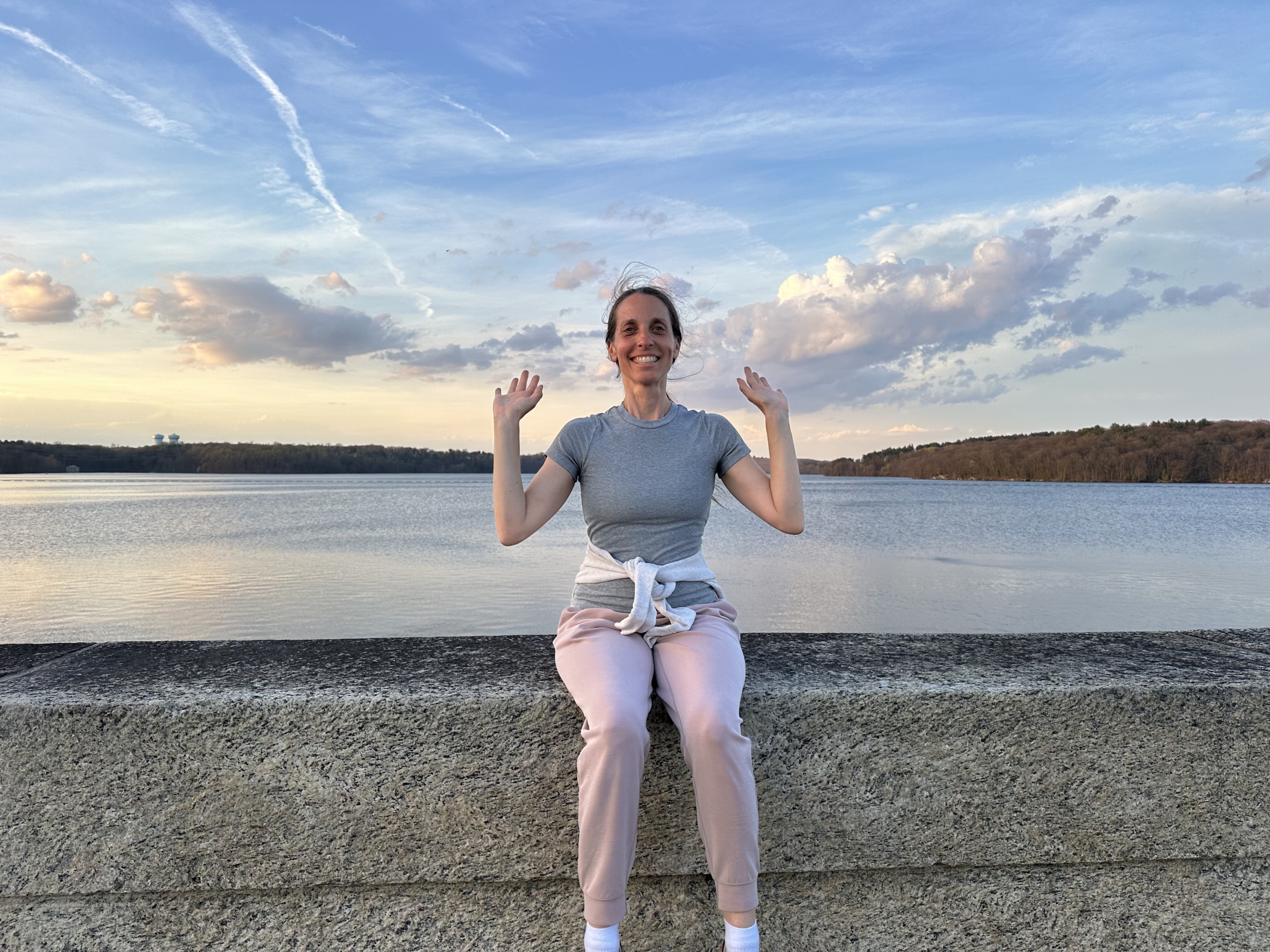
But how might we cultivate our own light when we are feeling a little heavy?
I find that when there is a feeling of inertia in the body or mind I have a really hard time beginning anything at all. I may contemplate the things I would love to achieve in a day, but the mere thought of them is exhausting and unless I make a plan, I may not get very far on my to-do list.
First I want to say that, sometimes, this is ok.
We live in an achievement oriented world where constant “doing,” constant activity, is valued at the expense of “being.” So listening to our body’s rhythms and doing less once in a while can be highly valuable and also more productive in the long run.
But how do we motivate ourselves if we are not “feeling it” and we need to get out of a rut?
The Thing About Procrastination
For me, it’s doing things in bite-size tasks.
If a list of things, or even one full thing seems out of reach, I whittle that down to one small step I can handle right now.
And I don’t put pressure on myself to get the whole thing done and usually, without that added pressure, I have no problem completing the task – the old Reverse Psychology. Then I feel a little lighter because I finished something and it is no longer sitting on my to do list.
Procrastination usually feels heavy.
If we are putting something off or avoiding it, it doesn’t just go away; it sits somewhere in our psyche taking up space.
So, we can cultivate lightness by working on things in smaller pieces. Even if we get just a little bit done we have started, and that in itself feels lighter.
Often starting something is the hardest part, right?
How Else Can We Cultivate Light?
I like to work on things I enjoy, such as a creative or passion project. Do you have a hobby that sparks joy for you?
Even if I have some trouble getting started, once I begin I quickly forget any resistance that hindered me and soon feel wholly engaged in the moment and immersed in the project – and this feels “light.”
Another big one for me is humor, along with the ability to see the bigger picture.
Seeing humor in situations, especially ones that may have otherwise felt bleak, has saved me on many occasions. Laughter is the best medicine, right? A cliche that truly holds its meaning.
And when we take a step back from a situation or experience in order to “see the bigger picture,” we create space. The close-up vantage point of something shows us every harsh detail, but if we can shift our vision or mindset into a more expansive and forgiving one, things feel, well, lighter.
Another important avenue for lightness is community and connection.
I’m a member of a hiking group; every week we meet at picturesque spots to traverse small or large mountains together, and when the weather gets warm there is an option to stay for a potluck picnic after.
Few things feel more lighthearted to me than spending time in the great outdoors with fellow nature lovers. Community, connection, and nature.
Just last weekend, I met up with my lovely hiking group at a spot on the Hudson River called Hook Mountain. We set forth on the 7 mile scenic path, along the Hudson River, before settling down for a picnic of homemade food (and with a water view to boot).
Did somebody say cultivating lightness?
And the best part is that these things that make us feel the most lighthearted are mostly free.
Money Doesn’t Buy Lightness
We don’t need a huge bank account to cultivate lightness.
In fact, the more we have sometimes the more heavy we feel. “Mo money mo problems,” as the song lyrics go.
We may think that buying new clothing or items or eating at that chichi restaurant will make us feel lighter or happier, and it might temporarily, but the truth is that accumulating things and overeating and drinking (which often happen when we go out to eat) are heavy, not light.
When I was younger I chased the feeling of lightness.
I thought going out to eat at restaurants (I was craving social connection) or buying something new (I was craving a new beginning or maybe a change in mindset) would help me feel lighter, but it rarely did … not for long anyway.
I now understand that lightness doesn’t come from the external world of form: it is generally not found in things we can buy (once our basic needs are satisfied).
It is found in the air on a mountaintop, in the sunlight shimmering down while we enjoy a picnic with friends, in the camaraderie of a group with a shared interest or passion, in the words of a meaningful story or text, in the care put into a homemade meal, in the feeling when we honor our body and give it a time-out or whatever it needs.
Balance in Body and Mind
I read something on social media recently that resonated with me.
I’m paraphrasing but the author said something like this: “My yoga practice used to be about what it looked like (next to a photo of her doing an advanced pose on a bridge) and now it’s about what it feels like (next to a photo of her in a more relaxed and less physical posture, not on a bridge).”
The first image conveys strength and triumph while the second conveys serenity and peace.
Neither is wrong; our yoga practice is about the balance of strength and softness, and which side of the spectrum we lean toward will depend on where we are in our lives along with a host of other factors.
As a fellow yogi and teacher, I can relate to the evolution of a practice.
For me, these days, feeling is much more important than appearance, which I suppose is partly due to aging and also due to the mind-body harmony we cultivate through our practice over the years … which really is the whole point of yoga.
As our mind and body becomes more integrated, as we become more “alive” in body and spirit AKA the present moment, there is less of a need or desire to prove ourselves, “show off,” or create an image.
If we use the Ayurvedic lens of the elements (water, earth, fire, and air) to view the seasons, we have good insight on how to create balance in our own mind and body.
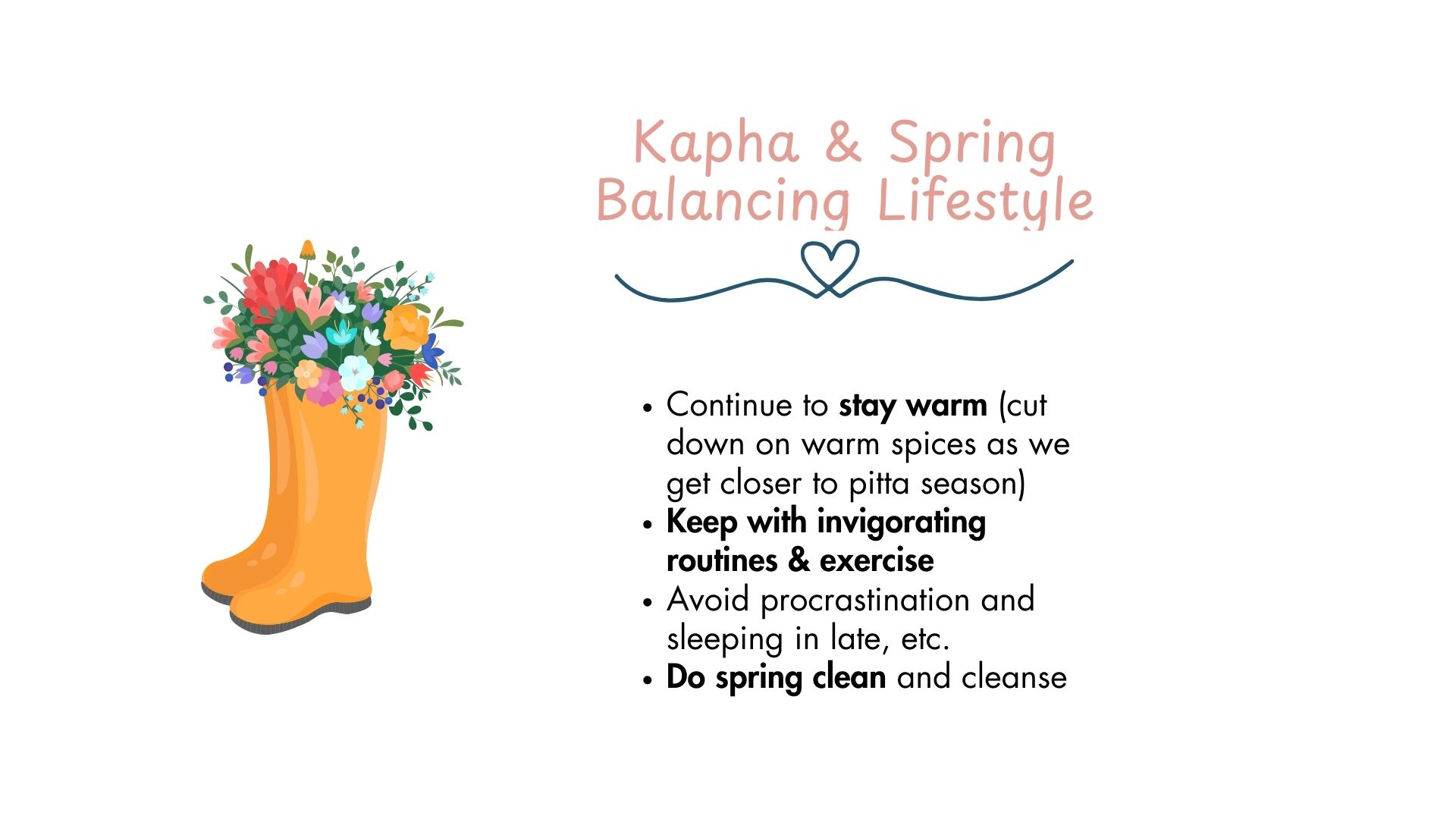
Recall that in the springtime the water and earth are the dominant elements. And the practice of Ayurveda is centered on the principle of creating balance by bringing in the opposing elements. For example, we balance the elements of water and earth by adding a little fire (warmth or heat) and air (lightness!) to the mix.
My yoga practice naturally shifts with the seasons.
When we are in tune to our own body this tends to happen without too much effort, but it is always a good practice, at any stage, to bring more awareness to what our body may need with each new season and, especially, in the transition from one season to the next.
This means, we can move at a slightly faster or more invigorating pace in our yoga or movement practices (if this feels right in our body), or attempt more challenging postures or exercises to build heat (again, always honoring our own body first and foremost).
We can also view our diet through the lens of the elements.
Keeping in mind that our own individual constitution (AKA our mind-body makeup) will be the primary guide, it is usually beneficial to add a little spice to our food during this cool and wet season.
Imagine having a cold or being congested. Would you want to eat oily or heavy foods? No, probably not (unless, perhaps, you are disconnected from your body); your body knows it needs a light warm broth, for example, or a little spice to clear out your sinuses, right?
There is a similar theme happening during the Springtime.
In general, during the Spring, we favor the warm, light, and dry qualities to balance the cool, wet, and heavy qualities. If possible, tend toward lighter meals with the mid-day meal being the largest, and try to avoid overeating.
Lastly, breathing practices to favor during Spring are:
Kapalabhati Breath, AKA Skull Shining Breath, and Nadi Shodhana AKA Alternate Nostril Breath. These are two of my favorite breath techniques.
Kapalabhati is known as a purification technique to counter sluggishness or heaviness in the body and mind. It works well for me when I am feeling a bit heavy in body and mind, and I tend to feel much lighter afterwards.
It’s a short, quick, and fairly strong exhale out the nose with a more passive inhale, meaning you’re not as focused on the inhale, which happens more naturally; the emphasis is on the exhale as you draw your belly back rapidly, in rhythm with your breath, toward your spine (this helps to tone the abdominal muscles, which is a great practice in the Spring).
Kapalabhati Breath is said to strengthen the abdominal muscles, increase cognitive function, and promote mental clarity. It’s a perfect morning practice to give a boost of energy and vitality (I haven’t swapped it for my morning coffee yet, but some would say it’s better than coffee).
*(There are some contraindications to be aware of as there are with most practices, such as pregnancy and those with high blood pressure or heart disease. In general, if you currently have any health issues consider a more gentle breathing practice.)
Nadi Shodhana or Alternate Nostril Breath is a more gentle breathing technique that helps to balance the brain hemispheres and settle the nervous system, calming the mind and body as the seasons shift.
It’s a fairly simple practice once you get the hand configuration down. Place the thumb of your right hand gently on your right nostril and your pinky and ring fingers gently on your left nostril. The other two fingers can rest on the bridge of your nose. (This is how I like to do it; there are other variations.) Inhale slowly and fully through your right nostril and exhale through the same right nostril. The breath should be slow and steady. Now plug the right nostril softly with your thumb and inhale and exhale slowly and completely through the left nostril. Plug the left nostril. Note that both nostrils will be plugged for a moment in between sides; you can increase or decrease the “hold” depending on what is comfortable. Now repeat the pattern. Keep going just like that, from side to side, for several rounds.
Nadi Shodhana is helpful at any time of day when one needs to increase clarity, focus, steadiness, and general wellbeing, but I especially love to do it in the evening as I am winding down from the day.
*(Avoid this practice if you have a cold, are congested, or have respiratory issues. There may be contraindications for high blood pressure, heart problems, or pregnancy when it comes to pausing the breath in between sides, which can be easily remedied by doing a more continual breath.)
Closing
Sometimes the opposite feeling or thing we desire is there to help us find the other side of it, and to create balance between the two.
By accepting how we feel – rather than making the feeling wrong – we can work to bring more balance, and in the case of this essay light, into our minds and hearts and lives.
We of course can’t feel light and carefree all the time. And we might not want to because then we wouldn’t appreciate the “light” as much, would we?
Just like passing clouds, rain, and thunderstorms our moods and energy levels change, too. There’s no use fighting against that and, in fact, when we accept things for how they are we tap into the whole rainbow of feelings that we might not have experienced otherwise.
We can observe and appreciate the qualities in the clouds and rain and also use them to appreciate even more when the sunshine and flowers arrive.