An excerpt from an essay in The Sun Magazine (I love this magazine with all my heart): “Looking back, I don’t know how I got through the anxiety and shame of early recovery. Sometimes the pain was so great it felt physical, and I sat twisting and moaning as if cloven feet were stamping through the chambers of my heart. But as the tiny pieces of my detonated life slowly drifted back to earth, I began working as a home-health aide, helping the elderly and caring for kids on occasion. A peaceful, sane existence began to take shape. The only problem was, I could no longer write. Somehow in sobriety I just didn’t have the juice to pump out pages and judge them as good or bad. Forced to acknowledge that I was a failure as a writer, I learned to live with my dashed dreams. That’s when it occurred to me that I didn’t have to write to prove to the world that I was a worthwhile human being or that all my pain and turmoil had a purpose. I wasn’t special – or, no more so that anyone else. It was time, finally, to grow up.” -Sybil Smith

I like these last lines very much. They feel wise and earned in a very real way. I have also thought that if I publish a book or attain some worldly success that all the “pain and turmoil” will then finally make sense, will, as Smith writes, have a purpose. But it seems that when we let go of the need to transform pain and turmoil into something that looks good from the outside, then the real healing and work can begin. I checked out Sybil Smith’s author website and saw that she in fact has numerous publications, and so it seems that by releasing her desire to prove something she did in fact reach her initial goals. I imagine in that “peaceful, sane existence” she discovered in life after addiction, that her work became deeper, more authentic and carefree (maybe she stopped caring so much about what other people thought) and that that shift, that “growing up,” enabled her to enjoy the success she had been chasing in her earlier life. I never liked the term “grow up,” because it tends to connote judgment, as in “grow up, already.” Maybe that’s because I did not want to grow up myself, to take on the responsibilities of adult life. As a child, I was acutely in tune to my parents’ pain and turmoil. Growing up did not seem fun.

J.M. Barrie, the author of Peter Pan, certainly did not value the idea of growing up. His preoccupation with youth stemmed, it seems, from a very sad, tragic past, and he did not seem to have the ability to “grow up” due to deep childhood wounds (and, interestingly, did not physically grow past the height of a child). I am realizing that we are privileged if we get to “grow up,” to experience (or earn) the sweetness of a “peaceful, sane existence.” Pixie dust is pretty and all but, in the end, it’s just an illusion.
Yesterday afternoon I walked in Rockefeller State Park. Blue sky. Soft breeze. Birds singing. Sun shining. It felt like the first official day of Spring … but my thoughts were not cooperating: they were spinning self-defeating little webs.

No matter what I did (yoga practice, walking in nature) I could not find the off switch for that pesky cluster of cells that Jill Bolte Taylor, in My Stroke of Insight, says lives in the left-brain hemisphere and is responsible for our maniacal thought streams. Round and round they go. Once the thoughts gain momentum they seem to have a life of their own and yesterday, despite my efforts, I could not detach from what they were telling me (that I have not reached the milestones that I should have by now, that I should give up on everything I’ve worked for because I am obviously not making any progress). As if that wasn’t enough doom and gloom, every bad memory (from the most minute to the more disturbing ones) seemed to be bubbling their way up into my consciousness.

I felt heavy, like it was a giant effort to place one foot in front of the other. A moderate hill that I usually enjoy walking up felt like Mount Everest. I was frustrated with myself because I knew I was wasting a beautiful day distracted by dark thoughts, and the more annoyed I became by my inability to ‘snap out of it’ the worse I felt.

Some days are just like that.

It feels impossible to detach from thoughts and the best we can do is to put one heavy foot in front of the other. I couldn’t even write my thoughts out yesterday because I felt so low and depleted. I stared at the computer screen for a few minutes and then promptly shut it down, poured a glass of wine and made dinner. The wine made me sleepy and I went to bed early, but it did not feel like what I needed.

Some nights I drink wine or eat cookies to stuff my emotions inside me and on other nights, I do a restorative yoga practice or a meditation or take a bath and read a book. It can be hard to do the thing that nourishes you when you want to reach for the cookies or the glass of wine (the quick fix) and, essentially, get numb. Knowing what’s behind the cookie or wine party can gradually shift the behavior. It is a process.

We must be kind to ourselves because when we beat ourselves up we wind up turning to the wrong things for comfort (at least the cookies don’t talk back). And, by the way, sometimes a glass of wine or sweet treat, in moderation, is just what the doctor ordered (if, of course, it is not a serious addiction). It just depends on what the motivation is, but being too strict with ourselves doesn’t tend to produce balance in our lives either.

I remember Eckhart Tolle (author of The Power of Now & A New Earth) revealing, in a live web discussion with Oprah (back in 2008), that people are often surprised to learn that he enjoys a cup of coffee or glass of wine. He added that it’s rare he will want a second cup/glass; I suppose because he is truly enjoying and present for his drink, so there is no need for more; there is no attachment to it. For us non-enlightened folks it may prove a tad more difficult to refrain from that second cup o’ joe but we can all bring more mindfulness into our days by slowing down, smelling the coffee 🙂 (really) and accepting that particular moment as it is, even and especially if it is a bad mood or a lot of self-defeating thoughts. The bad mood or thoughts tend to shift once we make some space for them.

And, so, this concludes my 30-day writing challenge. It wasn’t perfect but I reached my goal (this is more consecutive writing than I have done since I was in my MFA program) and I think, ultimately, that’s what counts. Yassas (cheers), as they say in the old country.


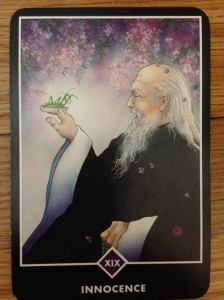
Tonight, I picked one of my Osho Zen Tarot cards for inspiration. I chose Innocence. Here is what Osho has to say: “The old IMG_1667man in this card radiates a childlike delight in the world. There is a sense of grace surrounding him, as if he is at home with himself and with what life has brought. He seems to be having a playful communication with the praying mantis on his finger, as if the two of them are the greatest friends. The pink flowers cascading around him represent a time of letting go, relaxation and sweetness. They are a response to his presence, a reflection of his own qualities. The innocence that comes from a deep experience of life is childlike, but not childish. The innocence of children is beautiful, but ignorant. It will be replaced by mistrust and doubt as the child grows and learns that the world can be a dangerous and threatening place. But the innocence of a life lived fully has a quality of wisdom and acceptance of the ever-changing wonder of life.”

An astrologer once told me that I was aging backward. As a Capricorn, he clarified, I become more youthful with age. “You are old when you’re young and young when you’re old,” were his exact words. Sounds about right, I thought. I was a cautious and shy child. My parents both worked full-time when I was young, and I missed my mother with urgency and desperation; in fact, I cried every morning when I remembered that she had already left for the train. My sweet grandmother, my Yiayia, soothed me and braided (and re-braided until I approved) my hair, made me breakfast  which included tea with milk and honey, just how I liked it.

I associate my warmest childhood memories with Yiayia and Papou. I was deeply loved. But nothing compared to having my mom around and I pined for her during those years. My dad was absent so often (he worked in the restaurant business) that I was accustomed to it, but it was a treat when he was home; we always did something fun, like searching for the Banshees, the magical, little creatures who lived in the woods, or going on a drive to Sleepy Hollow to catch a peak of the Headless Horseman (sometimes, he let me sit on his lap in the car and help steer) or even shopping (I once, around the age of 5, randomly requested a maroon colored woman’s purse; I still remember the scent of the leather and my mother’s disapproval.).

But as a young girl, I had, in true Capricorn form, the metaphoric weight of the world on my shoulders. Intuitively, I knew that something was very wrong in my parents’ lives and I carried that with me, a heavy backpack full of fear. I questioned my mother at a young age about the man in the moon. I could see the round, luminous globe in the sky and had spotted the outline of a figure inside it. He was an evil entity who would prey on us, a force threatening our safety and security. I wasn’t satisfied by my mother’s flippant response: “The man in the moon? Who told you that?” she laughed. She didn’t seem to understand the weight and urgency of the subject. “So he won’t hurt us?” I repeated.

When you live in a fearful state, the world is dangerous. The moon is not bright: it’s ominous.

As I age, that backpack lightens and I begin to see again, as if through a child’s eyes, the wonder around me. I have taken to placing my hands on trees when I pass them just to feel their tree-ness, looking up at the sky as often as possible, connecting with children and animals. I have no problem barking like a dog when I’m teaching a children’s yoga class; something you would have never caught me doing in my teenage or even young adult years; I would have felt too embarrassed, too self-conscious. I’m letting go of old, outworn items in my backpack. They were never my items to begin with. Pretty soon, I might even lose the backpack all together and, just possibly, replace it with wings. Wheeeee.

Here is the second card I picked:

IMG_1666

Today, a quote: “The primary distinction of the artist is that he must actively cultivate that state which most men, necessarily, must avoid: the state of being alone. – James Baldwin


Restorative Yoga is one of my favorite classes to teach and this amazes me. I am a Vata girl to the max. The Eastern Medicine system of Ayurveda posits that we are born with usually one or two doshas (body types), dominant. My dominant dosha is Vata, or the air element.

Vata people need to move. And movement is a good thing for people with this body type, however, as is usually the case in life, we need to find balance and there is a tendency toward too much movement for us vata folk. We can move so quickly that we don’t feel what’s going on in our bodies. Movement becomes a means to avoid. Vata people need to slow down enough (I’m not saying to a halt; stop and go energy exacerbates Vata – at least this Vata) to feel our bodies, to feel our emotions and get connected.

When the Vata dosha is out of balance we are disconnected, ungrounded — frantic, even.

Being a movement prone person, I rarely attended Restorative classes or slower moving classes, and would feel frustrated in yoga classes that began very slowly and sleepily. I wanted to get going! (That is also my pitta/fire speaking, which is my secondary dosha). So, I wink at the universe because of course I am a Restorative teacher. I think I get as much from teaching these classes as the students get from taking them. We all leave class calmer, lighter, and more grounded.

I think it’s safe to say that everyone, no matter what your primary dosha is, can benefit from time to just be. And although it is hard for most of us, especially Vata and Pitta souls it is vital for health. There is a growing field of research on the benefits of this type of practice.

A few months ago, my close friend’s grandmother, Gigi, died. This friend is like family–we’ve known one another since 2nd grade; my mom and her mom, M., are also longtime buddies, like sisters. My mom was helping M. clean out her mother’s home when they came across a box of Angel cards: “Messages from your Angels,” it reads on the outside of the box. M told my mom to give me the cards, knowing they’d be “up my alley” (as my mom likes to say).

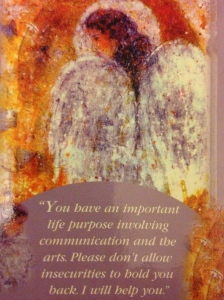
When my mom handed me the box that evening, I accidentally dropped it and one card slipped out and fell onto the floor. I picked it up; my Angel, Gabrielle, had a message for me. “You have an important life purpose involving communication and the arts. Please don’t allow insecurities to hold you back. I will help you.”

IMG_1497I have spent many years of my life in hiding, fearful of messing up or failing or maybe even shining too brightly. Over the last two years, since I began my yoga teaching career, I have taken more risks than ever before–leaving my zone of comfort and sharing my truth with others, opening my heart. Allowing myself to be vulnerable. It feels like coming out of the shadows. And some days, as I’ve written in past posts, the teaching feels inspired and connected, like a dance between myself and students. On other days, it’s more like an awkward first date: silence that feels strained and heavy. On those less than inspiring days, I gaze longingly at my old hiding spot, wondering why I left. My old insecurities re-emerge and cause me to question if this is an appropriate path for me; a shy girl.


Gabrielle, the Angel, reminds me that growth happens when we move into our fears, not away from them. I needed the encouragement on that particular evening and silently thanked Gigi for sharing her Angel cards with me.

Today I taught yoga classes for kids at a school carnival. These little people were so eager to listen and sing, and bring their hands together at their hearts. They also love barking in Downward Facing Dog, howling at the moon in Upward Facing Dog and hopping like bunny rabbits. They are pure joy. Pure love. They reminded me tonight, after a mundane day (the grey, damp weather reflecting the blah-ness of the day), of the joy in simple moments.

Last night, I was reading an article on Happiness in The Sun Magazine. The author, Mihaly Csiksgentmihalyi, writes: “Happiness is not something that happens. It is not the result of good fortune or random chance. It is not something that money can buy or power command. It does not depend on outside events, but, rather, on how we interpret them. Happiness, in fact, is a condition that must be prepared for, cultivated, and defended privately by each person. People who learn to control inner experience will be able to determine the quality of their lives, which is as close as any of us come to being happy.”

I feel, on some days, when the stars are aligned, hugely grateful for what I have in my life and, yet, on other days the things I do not have seem to be obstacles to my happiness. When I look around (especially in Facebook land) everyone my age seems to have basic external markers that I do not yet have and I wonder what the heck happened to me and sink into a state of lack and despair. It does not feel good there. It seems in these moments that those missing pieces will provide me with the happiness I seek, If I can just meet the right guy etc. And yet I know, on a deeper level, that external circumstances will never change the way I feel about myself, and will never make me truly happy if I am not already – at least not for long.

Csiksgentmihalyi (not even going to even try pronouncing that) reflects that happiness does not occur only when “external conditions are favorable” and, actually, seems to occur more when they are not (or at least when we have moved outside of comfort). He writes that those “who have lived through near-fatal physical dangers often recall that in the midst of their ordeal they experienced extraordinarily rich epiphanies in response to such simple events as hearing the song of a bird in the forest, completing a hard task, or sharing a crust of bread with a friend.”

I had once partially filled out a questionnaire for a website; the question I’d left off on was “Are you happy?” This question kept popping up in my inbox, a reminder that I had yet to complete the questionnaire. “Are you happy?” it chided me.

I finally filled the damn thing out. I checked “Yes”, knowing that I have the power to be happy right now, in each moment that I choose to be present. Maybe all I have to do is howl at the moon in Upward Facing Dog. Awwoooo!

Now that makes me happy.

Rain. The soothing tapping sound. The cleansing feel of it on my face, like lots of teardrops (no umbrella). Some days I love the gloominess of the rain.

Morning cuddles with my kitty cat. A few scratches thrown in the mix, of course (I am accustomed to having scratched up arms).

Peeling a big red “violation” sticker off my side window (I parked in a 2-hour visitor’s parking spot all day because I didn’t have my work parking permit). The rain helped.

Making progress on a work “to-do” list.

Early evening yoga practice with some core work … the feeling of building strength.

“Nonna’s pizza” from local pizza place. Pretty tasty.

A photo of my friend’s new puppy. Scrumptious.

A caring text from a friend.

My cat sticking his nose in my drink and then attempting to stick his paw into it. He likes ice cubes. Needless to say, it is now his drink.


I picked up an old issue of The Sun Magazine, realizing I had never read it, and am engrossed in the advice columns from Cary Tennis’ book, Citizens of the Dream: Advice on Writing, Painting, Playing, Acting, and Being.

A jazz pianist wrote to Cary for advice on his career/life path, explaining that he’s heading for his fifties and just sneaking by on his musician’s income. He writes, “We always hear heartwarming stories of people who followed their dream and never gave up and succeeded, but what of the people who followed their dream and failed?” He says that he once thought staying true to his art was everything but that now he yearns to know the satisfaction of earning a living. He’s sick of driving many miles for crappy gigs and money, and is concerned about his future.

The jazz pianist’s dilemma struck a chord with me (no pun intended).  I recently took on a part time office job that is unrelated to anything I am interested in but will enable me to make a living. When I was attempting to teach yoga full- time I felt stressed and pressured. I was ‘running around’ from class to class and subbing whenever I could, but it did not add up to a full-time salary. Subbing cannot be counted on for income and even permanent classes are subject to change, so there is little stability. And ‘god forbid’ I taught a class that was less than great; it sent me into a downward spiral of despair and doubt, questioning whether I was any good at teaching and if I could continue on this path at all.

Cary tells the jazz musician that when he first sat down to write to him he was at a loss; he had no words. He took some time away from the computer to clear his head but still no words came. But then he noticed a bumper sticker on a car that read “Real musicians have day jobs!” Cary writes, “… it was a needed reminder: Your music does not have to support you. In fact, your music might be happier if you were supporting it.” He encourages him to find part-time work to supplement his musical career or to even change paths completely if he chooses and play his music on the side. I found this oddly comforting.

The next question to Cary comes from a young woman who has had no worldly success with her writing, no tangible results to prove that her writing is worth pursuing. She wants to know when she should give up in terms of making a career of writing. Cary reminds her that writing is not only about “displaying one’s talent” but that writing is a “spiritual practice and mode of self-discovery.” He continues on to discuss the “practice,” the notion of putting in the work each day to improve one’s craft.

The universe has been sending lots of messages my way about practicing with consistency and love for the craft, and finding the grace to detach from the results. Practice is not about getting to an end point. I have been practicing every day (my writing, my yoga) and I feeling fuller, nourished, and more stable … those feelings I’d been looking for when I was  practicing erratically and praying I would get my big break at some point. It would still be great to get the big break but what is really great is simply feeling the effects of my practice in my body, mind and soul.

A dream: I had been shot twice in the area around my heart. I didn’t realize at first that I’d been shot, didn’t feel anything, but then I looked down at my chest and saw that I had two bloody wounds. I felt a tingling sensation, a quiet pain. It wasn’t the pain that concerned me but the knowledge that the wounds were much deeper and more severe than the pain indicated, and that I just couldn’t feel the full intensity of them yet. I didn’t know if the wounds were fatal so I asked a police officer for his assessment; he seemed to reassure me that I would be okay.

The wounds, I suspect, are symbolic of my father’s death and the slow process of connecting to such big emotions. I was, for a long time, disconnected from my emotions (a defense mechanism); my yoga and writing practices have helped to sync up my mind and body so I can feel what I am feeling, but, still, it is a slow process for me. I randomly cry in the car in response to a story on NPR (often one that seems, on the surface, unrelated) or a song.

Lately, what triggers me to feel are beings that are helpless or in pain. Since I was a little girl, I’ve had a soft spot for animals. Books like Where the Red Fern Grows were almost too much for me to handle; I cried like I had lost my own family member. As I grew older, I hardened and closed my heart and didn’t feel with the intensity I once had. I guess I learned that it wasn’t safe to be that vulnerable. A consistent yoga practice has helped me to re-open in the places I closed down, which brings connection and love and, also, vulnerability and pain. Recently, posts and petitions on social media about animals that are suffering hit me at the deepest places in my core and heart. I want to save them all. I want for them to be safe and comfortable and loved. I can’t stand the idea of them being alone and scared.

My brother’s recent decision to give up the dog he adopted, a dog who has anxiety and abandonment issues that affect his behavior and make it too difficult to have him in a small apartment, sent me into a tear fest. I couldn’t speak when I heard the news because my throat was so full of emotion. I cried for days. My words to my brother, just weeks before he made the decision, were: “Don’t give up on him!” I had sensed it.

My brother said something recently that surprised me: he said his dog’s face reminds him of our dad. We laughed and my brother’s wife asked what he meant but I knew immediately. It had occurred to me that my reaction to the news about the dog was connected to my father. My father was in pain for a long time, ever since I can remember, trapped by his addictions, and suffering immensely. He was also kind and big-hearted and cared deeply about other people, especially his family. He couldn’t show us in the same way a father who is “available” and “well” might, but I always felt his love.

We could not help my father. I watched him slowly devolve and deteriorate. I was in high school when I began to understand that something was very wrong. About a year before he died, I had little contact with him. There had been so many ups and downs (homeless shelters and veteran’s rehab and finally recovery and a period of health, but not for long) and I understood he would never change. I didn’t make a conscious effort to withdraw but it happened naturally (on both sides; he didn’t contact me often either) and I felt sad and guilty when I thought about him but every time I picked up the phone to call, or thought about visiting him, I could not do it.

I recently read in an interview (I think also in The Sun) that grieving is not a linear process  … like in my dream, it may take time to get to the depth of the real wound.


Seinfeld does a funny skit about “day guy” and “night guy.” Night guy, he says, sabotages day guy. Night guy is not at all concerned with day guy’s wake up time: day guy has to get up in 5 hours; oh well.

I think this skit is hilarious because I have a day guy/night guy personality. My “day guy” wants to get everything right, accomplish all the tasks on my “to do” list, eat healthy, exercise, and get to bed early, but by the time evening rolls around day guy is a goner and night guy is ready to parteeee (I’m thinking of the line from Bridesmaids–from the scene on the airplane), and by party I mostly mean staying up late to read, peruse the internet, or watch TV. Okay, okay, and eating way more than my body needs (this is where my dessert addiction comes in) and sometimes drinking vino. Before I know it, it’s way past day guy’s bedtime and I know day guy will be miserable in the morning (day guy is sensitive and needs beauty sleep), but it’s too late. The damage is done. Night guy has struck again.

How to integrate the day and night guys? Where do these disparate souls meet?

Day guy is great and all, always getting stuff done, but can become rigid and serious, consumed by the mundane details, whereas night guy is more about the big picture (he or she, as it were, enjoys reading Astrology and Mythology blogs at midnight) and couldn’t care less about the tasks on the “to do” list.

In order to honor both the night and day aspects of my personality I think I have to find equal time for being responsible and for being carefree, working hard and dancing in pajamas, accomplishing tasks and doing nothing. I think night guy is akin to the loose-y goose-y right brain hemisphere and day guy is aligned with the business-like left brain.

PS. I am in night guy mode at the moment and don’t feel like doing anything but sitting on the couch with a glass of vino and my kitty cat, which I will go do now. I will do my best to keep him in check, so that day guy can thrive tomorrow.

This is night guy signing off.

Tonight while I was teaching my yoga class I was present, fully present. There is a rhythmic flow that you can step inside of when you leave the thinking mind and teach from that higher, connected place; a dance between teacher and students ensues and it can feel magical. The sequence, the words, the technical aspects of the class fall into the background–they are there but it is the energy of the class that buoys everyone, that leaves both students and teacher feeling light and whole.

Unfortunately, there are also those classes that feel “off,” when you just can’t, for whatever reason, click in, find the beat. My voice, my words, my movements feel awkward and foreign to me and I struggle through the class like I was doing hard manual labor.

These “off” classes are, thankfully, more rare now but when I began teaching they happened a lot, probably due to old, deep fears of being “seen” and “heard.”

I wondered if it was a good idea to share this on my blog since I teach yoga for a living, but we all have “off” classes or days and to share these truths reveals our humanity and connects us to others. I am learning to move on more quickly from the classes or experiences in life that don’t go as well as I would have liked, and to keep in mind that it is all practice. The more I practice my craft the stronger and more experienced I become.

So instead of failing … how about falling. Falling is a part of the practice. I say this to students when they’re in Tree Pose because it can be so frustrating to feel unbalanced, but by the very nature of it one’s balance varies day to day, and there will always be some wobbling and, sometimes, falling.

The question is, can you fall gracefully? That is an art, too.


“The paradoxes of life are all there in the sea. The ocean is often referred to as feminine, but the weaves arrive in a masculine surge. As soon as they reach the full extent of their masculine expression, they shape themselves into a tube, a womb. . . . There are tempests and dark depths. You do not mess with the ocean. It will pummel you and chew you up. It is devastatingly brutal. And yet it can be luminous and delicate and tender. We clean our wounds there. What a reflection of our own impossible nature. We’re so brutal, so base, so horrific, and yet we have the capacity for such tenderness and warmth, such empathy, such generosity.” -Ran Ortner

I love the line: We clean our wounds there. I lingered over this sentence. I have always been drawn to the ocean. Although I did not grow up near the ocean, we are intimately acquainted. I’m Greek so I suppose the sea is in my blood. When I’m near the ocean I just feel right. The sounds. The smell. The feel of the air. It’s like coming home. There is nowhere else I’d rather be.

In my twenties, I spent two summers living and working near the ocean. It was not the best time in my life; I was feeling lost. I didn’t know which direction to move in career-wise or otherwise and felt stuck and defeated by past decisions (a recurring theme in my life).

When I look back at this time, I see it as a period of healing my wounds. Emotional issues from the past were coming up to the surface for confrontation. I spent many hours on the soft, warm sand, listening to the ocean and writing in my journals, diving into turbulent waves and cleaning wounds. Each morning before work I sat on the sand and drank my coffee, mesmerized by the wild, soothing waters. During that first summer I began creating again–writing and making art.

It was a time for touching heavy emotions and releasing them through creative expression. With the fierce, gentle ocean by my side.

Day 15 of my 30-day writing challenge. Halfway there. I was talking to a friend today about her new health plan; for the first 30 days it’s very structured and after that she will be more lenient but will stick to the overall nutritional plan because she feels great. I’m thinking of this writing challenge in the same way. It will feel like an accomplishment to hit day 30, but the point is to continue.

It’s said that it takes a minimum of 21 days to form a habit and, usually, for most people, between two to eight months. It’s not about 21 days or 66 days; it’s about forming a habit and then staying with it. No matter how long it takes. And, no, missing a day here and there will not doom you. We don’t have to be perfect. In fact, it’s not healthy.

I like this habit forming notion when it comes to writing. I’m exercising my writing muscle every day and it is starting to feel more natural. Some days I meet the screen with blank eyes and mind; I feel that I have nothing to write about but once I begin I’m surprised that I actually do. I am practicing. The biggest obstacle is letting go of the need for it be perfect.

It dawned on me last night, as I was scrounging for words, that I was having a hard time because I felt I had to put a cherry on top of each piece, to make it sweet and palatable and then I realized that no one wants to read that shit. I’m aiming, for the next 15 days (and more), to write truthfully and fearlessly, to be less afraid of sharing the real stuff.

In a past issue of The Sun Magazine (here’s some honesty: I am reading this 2012 issue for the first time; it has been hanging out on my book shelf since then. Interestingly enough, it came at the prefect time), Ran Ortner, an artist, is interviewed by Ariane Conrad. Conrad inquires: “I notice you don’t ever mention talent, something innate, a gift you have been granted”, and Ortner replies: “Talent is just the inner need. There is the Christian saying ‘Seek and ye shall find,’ but this does not convey the intensity. I think of the zen passage that says you should seek as if your hair is on fire and you’re looking for water. Intensity plays a huge role in the creative process. The deep need summons the resources required to achieve a breakthrough” (p.8).

Ortner goes on to discuss a period of his life when his work did not feel authentic and he lost his way, his sense of what art was. He stopped his art and began reading; he read not only the biographies of well-known artists but about many different fields, including psychology, spirituality and science, and what he surmised was that creativity is more closely linked to science than spirituality. Ortner tells Conrad: “Patterns emerged. A scientist and a monk and an artist are all looking for the same thing: some deeper reality outside themselves, or inside themselves. They are all involved in the same process: they have an inkling of possibility and are working to realize that potential. And there’s a process to finding it. You have to build up a practice, a system of approach, a set of resources – and from there you can confront the mystery. Everything I read pointed to deep research and arduous work – and then, in a relaxed moment, the aha. The epiphany comes from the concentrated endeavor, not despite it (p.9).

This message of hard, consistent, structured work is coming at me from all angles these days. It’s everywhere. In the wind. The sun (the real one and the magazine). The stars. Everything I read seems to contain this message. A couple of days ago, I picked up a Young Living (a company that makes essential oils) newsletter I’d been meaning to read for weeks and it contained the same message. I guess this is how the universe communicates with us. I am listening, universe. I read you loud and clear.