Ah, today. What can I say about today? I started the first day of my new job and like all first days it was a little (or a lot) chaotic, confusing, unsettling.  I felt the familiar pressure on my chest, that ‘uh-oh, what have I gotten myself into?’ feeling. I know that feeling well enough by now to know that it is just that, a feeling, and that it will pass.

So, how do we get through things that are difficult or uncomfortable or frustrating? Step by step. Breath by breath. One foot in front of the other.

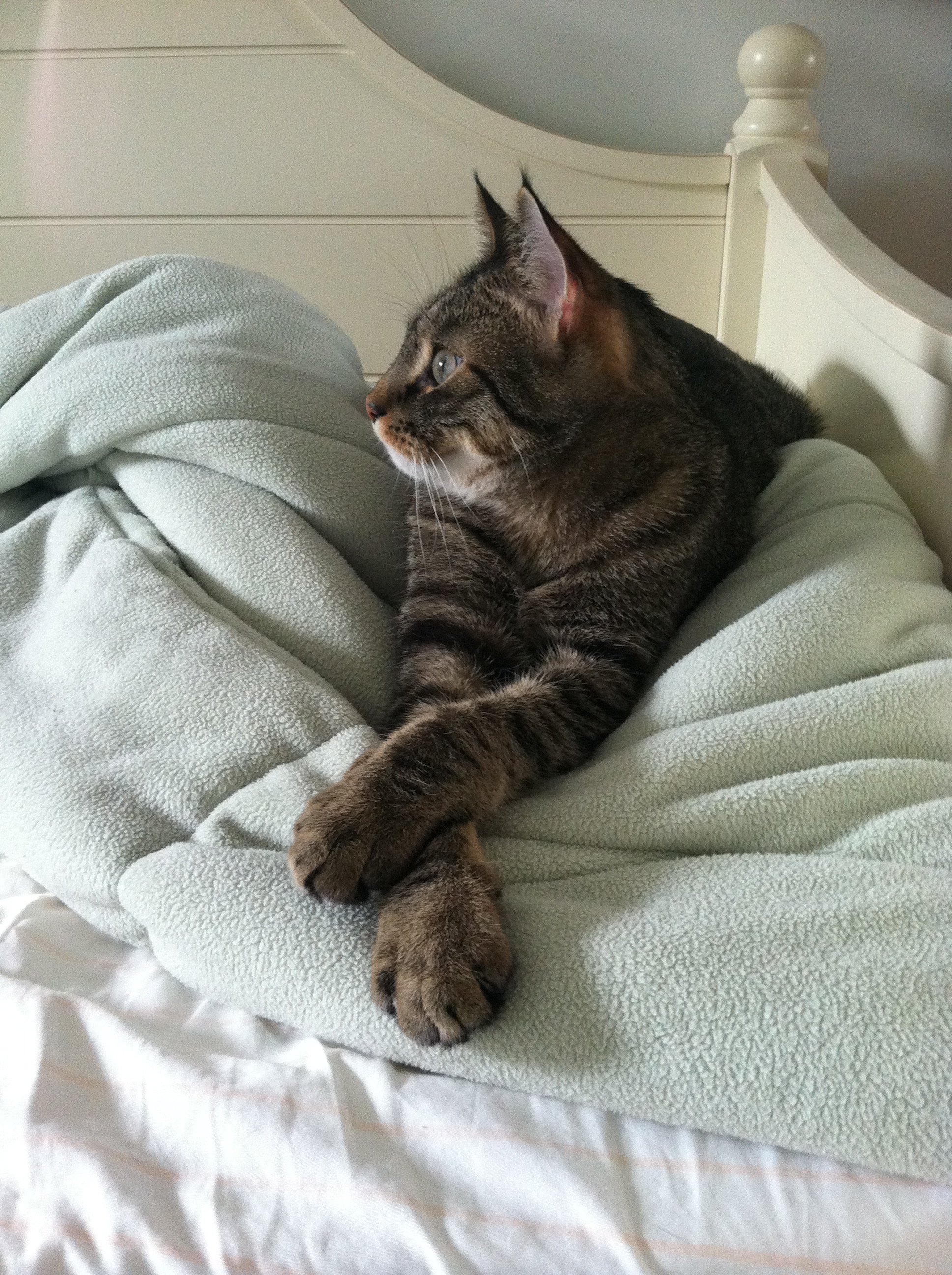
My cat has a clothing addiction. He loves to eat soft material, especially cashmere – what can I say, he has good taste. I have learned my lesson and keep all closets securely shut these days. A chair now serves as a barricade to my closet door after he broke in and had his way with a few sweaters. Sweaters, shirts, a few yoga pants and even a coat fell victim to the clothes addict.

I used to have a clothing addiction myself. No, I didn’t take bites of shirts and sweaters like my furry friend does, but I loved to buy new things to wear. I worked in retail, on and off, for years and I think I spent more money than I made on the merchandise. When I lived in San Francisco and worked in Finance, I bought a new garment regularly.

The outfits, the stuff, didn’t ever make me happy (for more than a few minutes) and now seem to me like armor, insulation, a way to not feel. A metaphor for a closed heart. My cat, Jespa, has taught me how to love again. Animals are pure; they teach unconditional love. Jespa has, literally and figuratively, bitten through my armor, the defenses that keep me hidden away from love and real emotions.

Who needs new clothes when you can have a little tiger friend?

IMG_1604 IMG_1605IMG_1601

A post, today, about my newfound love for essential oils. I began using them about a year ago and I think it’s safe to say that I am addicted. Just a warning: this is not a cheap hobby. I envision myself living in a tent or a van down by the river with nothing but my essential oils; at least I will smell good. Magical goodness in tiny bottles is what they are.

*Many years after writing this post I want to add that I no longer use the fancy brands, Young Living or Doterra, that I was convinced are the only pure brands on the market. I now think that is rubbish and that, mostly, they are just overpriced. I use Aura Cacia, a brand that Whole Foods sells and they smell exactly the same to me. There are also a lot of small/mom and pop organic/pure EO brands out there – do your research. The big companies say that only they have the equipment needed to purify the oils properly … I’m not buyin’ it (pun intended).

Ways to use the oils:

A few drops on a body part with a carrier oil (e..g, sesame oil), or you can do an an overall massage. The practice of Ayurveda suggests a self massage every morning before or after the shower to nourish your skin and also protect it before you go into the world — I use sesame oil, and it’s nice to add an essential oil if you can. Lately, I like Lemongrass.

A drop or two of peppermint oil or lemon oil, for example, in water or tea. I just ordered tangerine. Yum. BTW, you can also bake with them; I haven’t tried that yet. A drop or two of Thieves oil in water or juice if you’re feeling run down. (Addendum years later: I learned it is not safe to ingest them; they can burn your esophagus). 

Add several drops with filtered water to a diffuser and your home will smell divine. Every home should have a diffuser. 🙂

I also use the oils in spray bottles (filtered water with several drops of the oil) to purify the air. I use the spray bottles in my yoga classes during Savasana (the final resting pose) and sometimes to purify the room beforehand. Below is a photo of the oils I have been using lately in my classes (minus the lemon: I use that one at home to clean).

IMG_1606

An excerpt from Dani Shapiro’s Still Writing:

“When it comes to storytelling (and it’s all storytelling) I often tell my students that we need to be dumb like animals. Storytelling itself is primal. It’s the way we’ve always come to understand the world around us–whether recited around a campfire, or read aloud in an east village bar. And so it stands to reason that in order to tell our stories, we tap into something beyond the intellect –an understanding deeper than anything we can willfully engage. Overthink and our minds scramble, wondering: Should we go in this direction? Or that one? . . . But when we feel our way through a story, we are following a deep internal logic. The words precede us. We hear them. We sense their rightness. How did I do that, we ask ourselves, once we’ve finished, once the paint has dried, once we’ve worked through draft after draft after draft. . . . We are animals, our ears pricked, our eyes wide open. We put one hoof down, then another, on the soft and pliant earth. The rustle of a leaf. The crack of a branch. A passing breeze. We do no stop to ponder, What’s around the corner? We don’t know. There is only this: the bird’s nest, the fawn, the snake curled beneath the gnarled root of an ancient tree. There is only the sound of our own breath. Our pulsing bodies. We are here. Alive, alert, quivering. We are cave dwellers. With a sharpened arrowhead we make a picture. A boy. A bear. The moon” (150).

Did you ever notice in writing workshops that the students who were the best at critiquing others’ pieces weren’t always the strongest storytellers? I’m not saying that they were not strong writers–they were– but that there was sometimes something missing in their stories? The emotions we feel when we connect to a story has to do with the essence of you and me, which you cannot reach through the thinking brain. In my yoga & journaling workshop, we’ll use the yoga practice (i.e., meditative movement) to shift from the hustle bustle of the left brain hemisphere to the freedom of the right brain–to tap into something beyond intellect. It is in this more spacious state of being that we can connect to ourselves and the world around us: the rustle of a leaf. The crack of a branch, as Shapiro writes. From this centered place, we can express ourselves more authentically and create with our “sharpened arrowheads,” or whatever writing utensil you choose. 🙂 A Boy. A bear. The Moon. I


Today, on his birthday, a tribute to my father.

I’ve been reading books about the other side. I teeter between believing that my father is around me, watching me and helping me navigate this tricky earth plane to thinking he is simply, gone.

After he died, I saw cardinals on a walking trail near my home. My father loved the outdoors and I felt like the birds were a message from him or a sign that he was around. A few weeks later, I read a post on Facebook that said just that.

One day, some time after the cardinal spotting, I was planning my yoga class for later that day. I wanted to read a poem but wasn’t sure which one and so randomly opened the page to, you guessed it, a poem about a cardinal. I read the poem at the end of class that day. I wasn’t sure if anyone was listening.

A week or two later, I was feeling down in the dumps at the yoga studio I teach at. I was about to teach an evening class, which was unexpectedly big that evening; now on top of feeling depleted I felt a rush of the old anxiety around being seen and heard, surging through my body – I wanted to run away. That’s when I said the Hail Achilles (that’s my dad’s name) — Dad, I try not to ask for your help that often; I know you’re busy on the other side, doing your work, but I really need you right now.

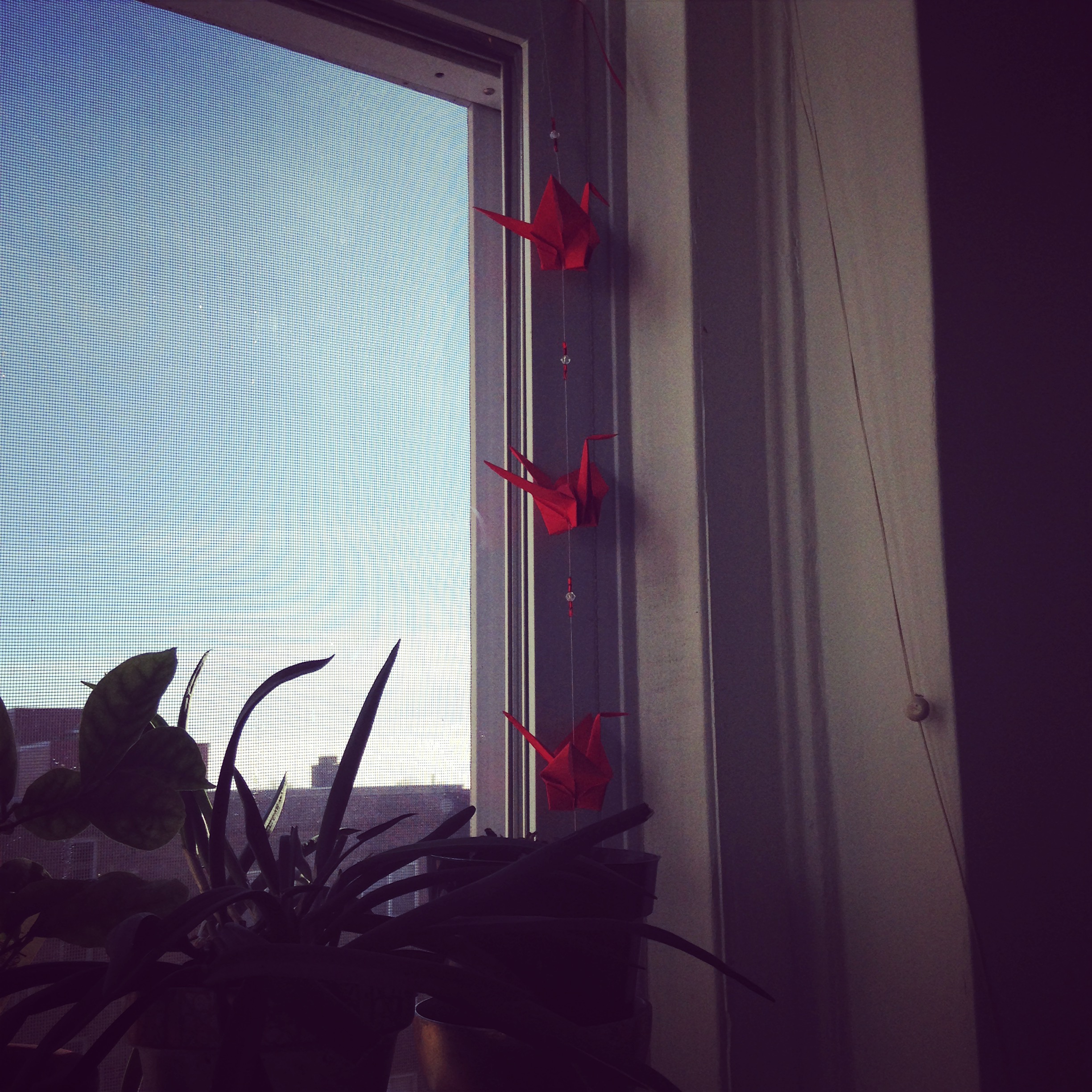
Just then a student (one of my favorite students for her kind nature) with long, thick red wavy hair waved to me. She said she had something for me and so I walked out of the studio with her, into the hallway, already feeling a slight shift in my anxiety; I was glad to be out of the studio where students were piling in. I felt like she had rescued me. She handed me a gift bag; I reached inside and pulled out a string of red paper birds; a mobile. I gasped. She had been touched by the poem I’d read in class, she said, and was inspired to make me these origami birds. As I held the birds in my hand, I felt a surge of energy, like being filled with bright light. I was suddenly on top of the world. I walked back into the studio, confident and whole. I was ready to begin class and it wound up being a lovely class filled with good energy, which I attribute as much to the students/the collective ‘energy’ as my own teaching and energy and, of course, the contribution of those I couldn’t see that night (thank you, Dad).

Cardinal calls me from the                       IMG_1519

Railing of the desk. “Turn

your world red,” he says,

insistent, beckoning. “Risk

life outside your hard-earned

walls and windows. Cast

aside caution, propriety,

and your too small sense

of what you can and cannot

do. Fly! I tell you that the

sky knows no constraints.

All you are or can be comes

clear in the near approach of

clouds. Fly! That which you

fear the most holds your

deepest teaching. Let your

spirit be the bridge between

safety and release. Soar to

the far end of what is known

from dawn to twilight, then

throw yourself at the whim

of the wild night winds.

Turn your world red, and

live with no regrets. Fly!

And if you are blown off

course, just change your

destination. Choose to

land wherever your two

feet are standing.

-Danna Faulds

Today, I took a yoga class today at the studio I teach at. It was a full class and as we were about to begin one last student made her way in. She paused, yoga mat, handbag, and water bottle in hand. There was a good-sized space between two mats in front of me, and a student next to the space waved her over.

The woman didn’t budge.

When F., our teacher, spotted her he walked over and stood in the space, smiling and motioning her to settle here. She moved tentatively, her body stiff, and unrolled her mat, plopping her giant handbag and other belongings onto the floor beside it. She stood awkwardly on her mat, as though she didn’t know why she was here, and looked around suspiciously at the grey folding chairs that were surrounding everyone’s mats; F. had asked each student to take a chair for today’s practice. The room had lots of stuff in it.

Although I didn’t have a full view of this woman’s face (I could see her only from the side), I had the distinct feeling that she was not amenable to the chair situation, maybe downright pissed about it. She made a face and asked the student next to her a question, ostensibly about the chairs and when the student answered and pointed to the extra chairs at the side of room, she seemed to answer curtly. The other student’s eyes widened and she took a step back on her mat.

F. approached (let’s call her) grumpy pants, handing her a chair and the necessary props for the practice. She begrudgingly accepted them. I wondered why, in a room full of students, my energy had propelled toward the one person who had woken up on the wrong side of the bed. I felt my heart rate quicken and that old, familiar sense of unease, of something not being right.

I breathed a little deeper as we reached our arms skyward. My gaze traveled through the window that was directly in my line of view, meeting the Hudson river. Hello water. I did my best not to notice when Grumpy P, in the middle of the pose, reached into her handbag and took her phone out. In her defense, she may have been turning it on silent.

As the class progressed, my focus moved away from my chair-hating friend and I didn’t think about her again. At the end of class, after a long Savasana (the resting pose) and a sweet serenade by F., we were all feeling pretty good. I had almost dozed off I was so relaxed.  I glanced at Grumpy P and saw that she had lightened, her face visibly softer, and I’d wondered if I’d imagined the whole thing. Maybe she had not been in a bad mood after all.

Or maybe the yoga practice had worked its magic.

We all come to the mat feeling wretched some days. These are the days we most need our practice and the days it’s hardest to get there. I was reminded in that moment all over again of the profound healing potential of the practice.

Showing up for day 3 of my writing challenge (write every day, even if it’s for 10 minutes). Today may be a 10 minute kind of day. White is floating around in the sky.

This morning I drove to an interview for a summer yoga teacher position, teaching kids. The interview was in the same city I live in and yet I got lost for a few minutes (not a surprise to those who know me and my spatial challenges): my GPS lead me astray –recalculating, recalculating, GPS lady bellowed.

Recalculate is now one of my least favorite words.

I realized on the way home from the interview that, although I enjoyed the conversation with the man who interviewed me, the position wasn’t right for me. I feel disappointed and other deeper feelings about my wayward career path and purpose in life have come to the fore.

Do your yoga now, my higher self (the wiser self) pipes in. I shrug. And feel my clenched jaw. My constricted throat. I try to breathe into those places but it feels half-assed. It’s interesting: when we most need the tools at our disposal we don’t want to reach for them.

With each sentence I write a bit of tension is released. My heart softens. I regain my sense of humor.

Recalculating.

The little snowflakes are hustling to reach the ground now. They went from meandering around to being on a mission.

The act of writing, formulating sentences, pinpointing feelings and releasing them to the page (or screen as it were) is healing for me. It’s like having a conversation with yourself; it creates space between you and your bad mood, or whatever event is causing you to feel stressed.

I am thinking about writing at the same time every day, in the morning. Sy Safransky shares his rituals around his writing practice in the February issue of The Sun. He wakes every morning (or most mornings), before the sun comes up, to write. I write at different times each day; erratic even within the consistency. I understand how the ritual of waking each morning to write can put you into a rhythm, a forward motion, which is easier to step inside of. I want to step inside of that.

I am not a morning person. I avoid mornings, sleeping until the last possible minute, yet feel a sense of loss at having missed the sacred morning hours, having rushed through them to get to where I need to be, and then feeling plagued all day with a need to “catch up,” to fit in everything I want to accomplish.

It’s time to face the morning. What am I so scared of anyway? The sunshine?

Here I am showing up to my practice. This is not easy for me; my writing practice has been ruled by inspiration and inspiration alone, which comes and goes like the wind or ever-changing moon, and so it has been a spotty practice. A wildly erratic practice, in fact. Making this commitment to write each day, even if it’s just for 10 minutes, feels good. And scary (am I up for the challenge, now that I have boldly announced it?). And a little boring (every day?). But also refreshing and exciting within the boringness (is boringness a word?). I have nothing to say, was my first thought after logging onto my blog. But now, look, whaddayaknow, I have completed a paragraph. It’s a start! And the starting is the hardest part.

I am trying (oh-so hard) not to edit and judge my words as I type them, but to allow them to be, just be (I can always go back and revise after, I reassure my inner critic). I have come to realize that one of my biggest blocks to fulfilling my goals/dreams is perfection (aka a fear of messing up). Perfection is the pesky culprit of procrastination and sucks the life right out of creativity. I am learning how to gracefully accept my flubs, to be kinder to myself when I mess up, so that I don’t send my creative spirit into hiding, where she has already spent too much time.

I have recently begun teaching classes that blend yoga and journaling. This class is about creative self expression. We move slowly, steadily (one breath at a time) away from our analytical left brain and into the open, bright space that can be accessed in our hippy-loving right brain, so that we can express ourselves freely, with abandon (no rules; just write). In intervals throughout the practice, I offer creative inspiration and writing prompts and then invite students to jot down images, snippets of memories, draw pictures … to release onto paper whatever is bubbling to the surface. The writing does not have to be profound. It does not have to be poetic. It does not have to be anything. That is the beauty of the practice. We are giving our well-meaning but annoying friend, perfection, the boot for the day.

I recently read Dani Shapiro’s Still Writing. She writes: “The two greatest shocks I have experienced–my parents’ accident and my son’s illness–ignited in me what had been an already flickering flame of awareness–some might even say a hyperawareness–that life is fragile. That bad things have happened and, without a doubt, will again. That to love anything at all is to become able to lose it. Some days, this awareness gets the better of me. Anxiety sets in. I grow impatient and controlling. Or I retreat from the world. But more often than not, this burden of accumulation feels like a gift. It has taught me that ordinary life–or what Joan Didion calls ‘ordinary blessings’–is what is most precious. … We are revealed to ourselves–just as our characters are revealed to us–through our daily actions. When making my son’s breakfast, I try to focus simply on cracking the eggs, melting the butter, toasting the bread. It doesn’t get more elemental than that. As I drive down country roads taking Jacob to school, I remind myself to focus on the way the sunlight plays on the surface of a pond, the silhouettes of cows in a field. I’ve learned that it isn’t so easy to witness what is actually happening. The eggs, the cows. But my days are made of of these moments. If I dismiss the ordinary–waiting for the special, the extreme, the extraordinary to happen–I may just miss my life” (p.123).

And so, word by ordinary word, I am creating. I am practicing. One word in front of the other. One word at a time. You get the idea. Just get them out, and onto paper or screen. That is the secret (to Still Writing; as in “are you still writing?”). I finally understand.

Last weekend, I had plans to have tea with a student from my yoga class. We had been saying for months that we would get together and had finally set a date. I planned to get a certain amount of work accomplished in the first half of the day, and when the time to meet neared I realized I had not met my goal. I thought for a moment about asking if we could reschedule and was answered by my inner voice: “Stick to your commitments.” So I bundled up in my winter gear and stepped into the cold air. The snow had been whirling down from the sky all day. I walked the 15 minute path to the cafe, welcoming the feel of snowflakes on my face.

At the cafe, I ordered a green tea and sat at a small table, watching the door until I spotted my friend/student. I had not seen her in months and after we hugged, she pointed to her belly as she unbuttoned her coat. She was pregnant! She had trekked in the snow to meet me. She was happy to get outside and move her body, she said. We sat there, at the cafe, chatting about life for hours. It’s rare to meet people you feel completely comfortable around and she is one of those people.

I am working on sticking to my commitments (to myself and others) every day. Step by step. I realize now that every seemingly small decision counts, that all of the day-to-choices we make accumulate into something big: our reality. These daily decisions and habits are the threads of the tapestry that become our life experience. (I shared this sentiment in my yoga class a couple of weeks ago and one student exclaimed aloud, “I’m in trouble!”). It’s okay if we mess up; it’s unavoidable.  This isn’t meant to be a militant message (clean up your act or else!); it is simply a reminder that we have the power to change. At any moment. With each decision we confront.

Later that day, after meeting my friend for tea, I was back home doing research for a job I would be interviewing for and came across this sentence: “Excellent outcomes are the result of excellent habits,” followed with a quote by Aristotle: “We are what we repeatedly do.” I let the message sink in.

I take a lot of classes during the week on YogaGlo (online yoga classes). One of my teachers on the site, Marc Holzman, teaches a class called “The 60:60 Challenge for Endurance, Strength and Detachment.” Marc instructs us to hold each pose for 60 seconds throughout a 6o minute practice, committing fully to each posture, slowing down the practice enough to feel what’s happening in your body and mind. He reminds students that consistency, practicing each day (even if it’s only for 10 minutes) is the key to meeting your goals. It’s not the action of making goals that allows us to attain them (although that is step 1); it’s doing the work each day: that nitty gritty work that we (read: I) love to avoid. Marc says, the cool thing is that you can detach from the goal because you’re putting in the daily work that will take you to where you need to go; that’s when trust comes in. You can’t rely on motivation or inspiration alone because those guys are fickle and elusive; it is consistency that you must befriend. For those of us who are not exactly consistent by nature (hello fellow Vata friends), it is a hard earned lesson and one that needs to be learned over and over.

In the “60:60” class, Marc discusses the art of writing as an example of consistency. Lately, he shares, he has read a lot of blogs whose authors repeat the same message: the key to success is doing something, in this case writing, every single day (that slightly annoying hashtag #yogaeverydamnday makes more sense to me now): wake up each morning and practice (yoga, write, meditate).

Last night, I was reading Sy Safransky’s preface to his new book, Many Alarm Clocks, in the February 2015 issue of The Sun. He wrote this: “I write in my notebook early in the morning, almost always before the sun comes up. Some of the entries are long and carefully considered; some are just two or three run-on sentences; fragments of essays I’ll never write, snatches of conversation, postcards from the dream realm … I usually write each morning for at least one hour; on some mornings maybe a half-hour. Writing something every day is important to me – no matter how little sleep I’ve gotten or what mood I’m in. When I’m faithful to the practice, my skin has a rosy glow, the car starts in the morning, my cats come when I call. But I’m not always faithful. Sometimes I oversleep, or I wake up worried about an impending deadline and head straight to the office. Even then, I try to remember what the physician-poet William Carlos Williams said. He was also a busy man, known to compose poems between patients. He insisted that ‘five minutes, ten minutes, can always be found.'”

I like the feeling of being faithful to my practice.