
Functional Freeze and Vinyasa Flow
I spent many years, unbeknownst to me at the time, in a Functional Freeze state of being. I knew something wasn’t right but I didn’t understand exactly what or how to change it.
Functional freeze is a mental state in which someone continues to function in daily life while their nervous system remains in a “freeze” response, often resulting in feelings of numbness, exhaustion, overwhelm, sluggishness, hopelessness, and disconnection. It often manifests as a feeling of being stuck.
I think it’s safe to say that Functional Freeze is the opposite of our theme for this month: Adaptability and Flow.
If we’re cut off from our “feeling body” (i.e., numb), we lose the ability to gauge not only what we feel but what we genuinely need and want. We lose the ability to trust our instincts and intuition. In this state, transitions are clunky and misguided at best.
This is where Vinyasa Yoga, or any meditative practice that links the breath and body, comes in.
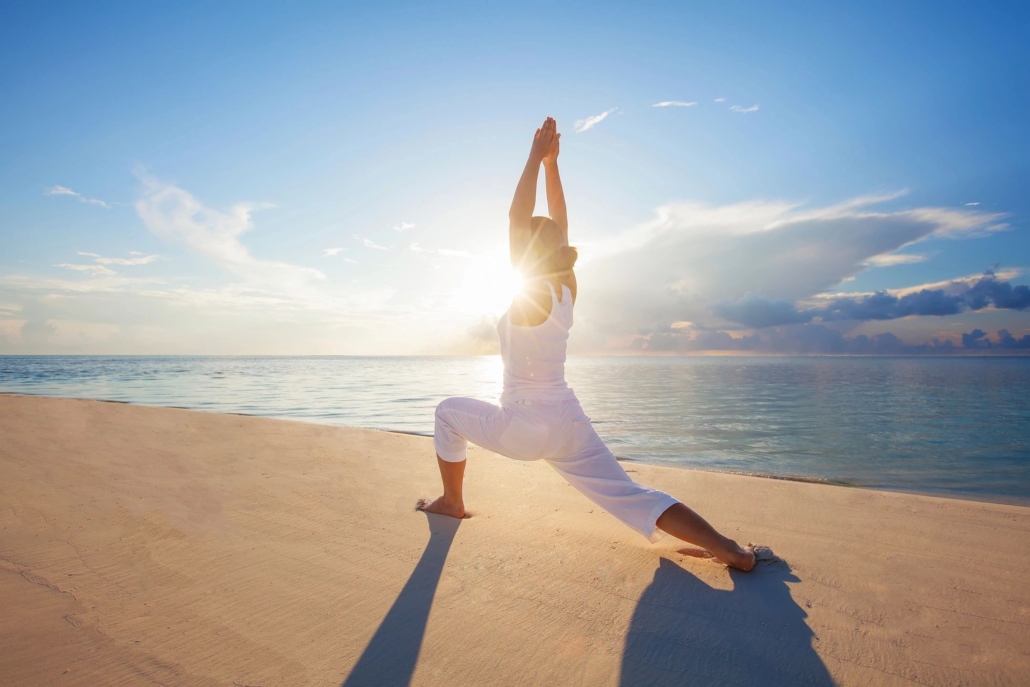
Nearly two decades ago, I began a consistent yoga practice and I eventually started teaching yoga. In the beginning of my yoga journey, I was most drawn to the Vinyasa Flow style that links postures with breath, ideally connecting each breath with each movement.
The feeling of flow took me out of my “stuck” state and into my body, and I remember having the feeling that I was thawing out.
And, in a way, I was.
I remember how satisfying it felt to practice purposeful transitions on my yoga mat, linking one posture to the next. Moving with grace and care, like a rhythmic dance. I needed this type of movement to come into balance, to get unstuck.
An image comes to mind of grandmother moon (the full moon) watching over the ocean, directing the ebb and flow of the tides. Water flows because it’s responsive. In the Vinyasa Flow practice, we learn to connect and respond to the rhythms of our own body.
The Opposite of Vinyasa Flow
Enter Iyengar Yoga.
Just as I was naturally drawn to the Vinyasa Flow practice because it offered what I needed for balance and well-being, I was somewhat repelled by the Iyengar practice.
If you’re not familiar, Iyengar focuses heavily on anatomical alignment and is structured more like a workshop than a class, as I describe in an essay I wrote for Elephant Journal in 2014, entitled: “How I tried to Love Iyengar and Give Myself (Yoga) Props.
You could say Iyengar yoga is more cerebral than other styles of yoga in that there’s a lot of chatter and mental focus, which is not exactly helpful for someone who is already “in their head.”
Iyengar doesn’t involve a lot of movement with the exception of gathering every single yoga prop ever invented and shuffling your mat with said props from the center of the room to the wall and back again – what felt to me, at the time, like carting around baggage I didn’t want or need.
In this style of yoga, students hold each pose for what feels like an eternity in order to perfect and go deeper into their alignment.
In my mind, the Iyengar class was led by militant teachers that controlled every detail of the practice, which only exacerbated my stuck state of being. It was the opposite of “flowing,” and the sense of freedom I was so desperately seeking.
All these years later, I understand the Iyengar journey to go deeper into each posture by using the support of props and tuning into alignment. And I get how that structure and support can also provide a sense of opening and freedom. Although Iyengar will probably never be my “go to” practice, I can accept and receive the benefits of it now.
That said, we generally need practices and tools that help us to balance our inner state; if someone is in a functional freeze, Iyengar might not be the best remedy, at least not initially.
For those with complex or acute trauma, or simply more rigid personality types, the term “going with the flow” might create some confusion – we may understand, on some level, that we’re not in a flow state, i.e., the ability to shift from one thing to the next with grace or ease, to roll with the punches, so to speak, and progress and thrive in our lives … but how to actually “go with the flow” may feel abstract like a math formula that never quite clicked.
Let’s break down “going with the flow” a bit more.

Tuning In and Adapting
In my yoga classes, I often invite students to connect with the natural rhythms of their bodies, starting with their breath. I may ask them to notice where they feel their breath in their body or where their breath meets their body. I want to provide clear instruction and support while also giving students enough space to connect with their own experience and needs.
But “tuning in” in this way, connecting to our own needs and rhythms, may be tricky at first; we may have learned to tune out as a coping mechanism, as a way to regain a sense of control in chaos.
We first learn how to connect with ourselves, which we can do through simple mind-body exercises, such as breathing more deeply into body parts and noticing what we feel, or directing our breath to certain body parts and noticing how that may ease a sensation or emotion.
We learn not only to trust our body’s wisdom but also our environment, to have some faith that it will provide us with what we need.
As we learn to trust ourselves and the world around us, we adapt more easily to changing environments, circumstances, and people … and this, I think, is how we begin to go with the flow.
Flowing & Adapting Require Strong Roots
When plans or circumstances change or when something is very challenging, the body reacts before the mind and we may go into a fight-flight-freeze mode.
Flow requires nervous system capacity, but rigidity is often a way to protect ourselves from what feels threatening.
When we become too rigid, it hinders our ability to move with the natural rhythms of life. Imagine the ocean water frozen and disconnected from the moon’s guidance, unable to respond, unable to ebb and flow.
On the yoga mat, we don’t force flexibility (that will only cause injury); we work with what our body is capable of in the present moment and we create conditions for the body to grow more flexible over time.
The paradox is this: the ability to be flexible and flow emerges from stability. We don’t flow (at least not well) from a misaligned or weak base.
As I often remind my students in class, before we can flow safely we need to create a solid foundation – this includes setting ourselves up well in the postures (I’ll admit, this is where the Iyengar practice can enhance Flow) and developing our core strength.
In Warrior 2, for example, we ensure that our foundation – the body parts touching the ground, in this case our feet – is well aligned. If not, the entire posture will be “off.”
When our feet and legs are well-aligned in Warrior 2 we feel steady and stable. From there, we can play with “flowing” through a Dancing Warrior sequence (Warrior 2, Peaceful Warrior, Extended side-angle, and back through again for a few rounds).
Flowing and adaptability require strong roots; the ability to move fluidly comes from that deeper place.

What Flow Looks Like in Real Life & How Resistance Helps
Flow can sound somewhat mystical or effortless, but in reality it’s really pretty ordinary.
It might look like noticing that a plan you mapped out for the day has fallen apart, and instead of spiraling into frustration, you take a moment and ask: What’s possible now?
It might look like a conversation that changes course and instead of clinging to what you planned to say, you listen more closely and respond from there.
It might look like moments when the script you imagined (for teaching, parenting, a work presentation, etc.) isn’t working and you respond to what is actually happening in front of you.
Flow doesn’t mean that things are easy or that we don’t feel resistance. In fact, resistance is often a doorway to flow. When we feel the urge to control, push, or shut down, we have an opportunity to stop and reconnect with our foundation: our breath, our body, the present moment.
We learn to adapt.
In yoga, this might mean choosing a different version of a pose when the one you want to do doesn’t feel right in your body that day. On and off the mat, it might mean adjusting expectations or attitude, shifting direction, or considering a new angle.
Flow is also about learning when we need more structure and when we need more space.
As in the practice of yoga, we aim to find the balance of effort and ease, structure and surrender.
And like any skill, it grows with practice.
The Myth of Going with the Flow
I think it’s worth mentioning that the phrase “Going with the flow” can come across as dismissive, or even make us feel that we need to just “go with” whatever comes our way, and ignore any resistance that comes up. This is why we learn to tune into our bodies and needs; it’s important to remember there’s always a balance to be struck.
Adaptability doesn’t mean going along with or agreeing to things that aren’t a good fit or don’t feel right, and it absolutely doesn’t mean accepting mistreatment of any kind.
Sometimes the most adaptable thing we can do is say no.
Closing: Flow as Freedom
Freedom is not the absence of obstacles, it’s the capacity to respond.
Just as the tides respond to the moon and move naturally under her guidance and wisdom, we can learn to move with the ebb and flow of our own internal rhythms and those of the environment around us.
As we move through March, notice where life is asking you to adapt and flow.

